
I am an early-career researcher in Human-Computer Interaction (HCI) and an Adjunct Researcher with the Embodied Visualisation (EmVis) Research Group at Monash University. My research focuses on human-AI interaction in spatial environments, combining embodied interaction, immersive technologies, spatial cognition, and human-centred artificial intelligence to design intelligent systems that augment human capabilities.
My work investigates how people perceive, interact with, and collaborate with intelligent systems in physical and virtual environments. I develop and evaluate immersive and embodied interfaces that leverage virtual and augmented reality, gesture-based interaction, and AI-assisted technologies to support learning, decision-making, and collaboration. Through this research, I seek to understand human behaviour in complex interactive settings and to design interaction techniques that are intuitive, effective, and trustworthy.
Working across healthcare, education, simulation-based training, and smart manufacturing, I employ interdisciplinary approaches to create and study human-centred technologies that facilitate productive collaboration between people and intelligent agents. My long-term research goal is to advance the design of intelligent spatial systems that seamlessly integrate human and artificial intelligence, enabling more natural, effective, and trustworthy interactions in increasingly autonomous environments.
Research Keywords: Immersive Analytics Augmented/Virtual Reality Human-Centred AI Spatial Computing
Recent Publications
HandovAR: Towards AR and AI Support for ICU Nurse Handover
Mengxing Li, Phoebe Zhang, Jiazhou Liu, Agnes Haryanto, Kadek Ananta Satriadi, Trung Nguyen, Deval Mehta, Zerina Lokmic-Tomkins, and Tim Dwyer
Published at CHI-EA 2026 as a workshop-position paper.
Effects of interface layouts on cognitive performance for pedicle screw placement simulator in immersive environments
Lang Qin, Kadek Ananta Satriadi , Jiazhou Liu, Yuhan Zhan, Jiang Shao, Peimeng Liu, Zhiyong Chen, Yongtao Liu
Published at IJHCS 2025 as a full paper.
Human Factors in Immersive Analytics
Yi Li, Kadek Ananta Satriadi, Jiazhou Liu, Anjali Khurana, Zhiqing Wu, Benjamin Tag, Tim Dwyer
Published at IEEE VIS 2025 as a workshop-proposal.
SAMMed-VR: Integrated Segment Anything Model in Virtual Reality for Supervised Brain Tumour Segmentation
Vahid Pooryousef, Himashi Peiris, Huiyi Liang, Ang Li, Zhaolin Chen, Tim Dwyer, Jiazhou Liu
Published at IEEE VIS 2025 as a poster paper.
Investigating the effects of physical landmarks on spatial memory for information visualisation in augmented reality
Jiazhou Liu, Kadek Ananta Satriadi, Barrett Ens, Tim Dwyer
Published at IEEE ISMAR 2024 as a full paper.
Featured Projects

AI-facilitated AR Handover System for ICU Nurses
This project addresses the challenges in the nurse handover process in critical care settings by designing an integrated solution that leverages immersive and AI technologies. We propose an integrated approach consisting of the following innovative concepts: in-situ augmented reality (AR) overlays, an AI-assisted conversational agent, and a cross-reality collaborative model.

AI-facilitated Brain Tumour Segmentation in Immersive Environments
This project develops an AI-driven system to automate brain tumour segmentation from complex 3D MRI scans, reducing the need for time-consuming and error-prone manual annotation by medical experts. It combines deep learning models with immersive visualisation (e.g., AR/VR), allowing clinicians to interact with and refine tumour predictions directly in 3D space.
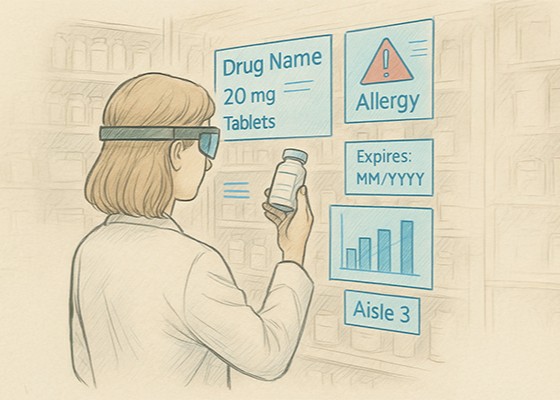
SafePhARm: Safe and Efficient Pharmacy Practice Through Augmented Reality
SafePhARm project explores the use of Augmented Reality (AR) to provide context-aware information directly within pharmacists’ field of view. It aims to identify workflow inefficiencies, co-design AR interfaces with pharmacists, and develop a proof-of-concept prototype. The system will be evaluated in a controlled environment to assess its impact on task efficiency, usability, and cognitive load, ultimately generating design guidelines and evidence for AR-enabled digital health solutions.
Selected Publications
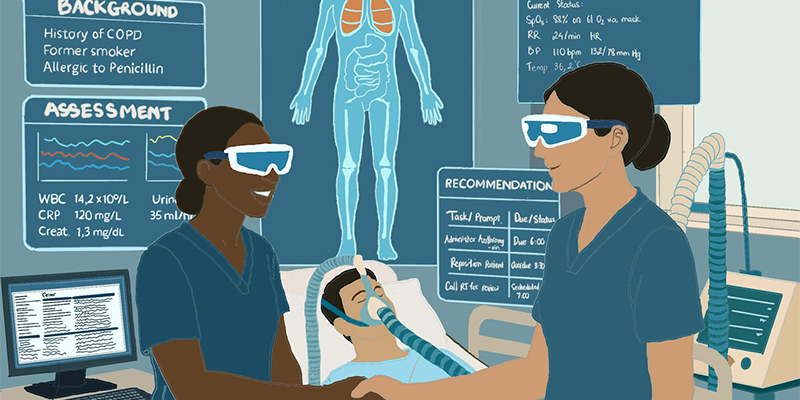
HandovAR: Towards AR and AI Support for ICU Nurse Handover
We conducted seven interviews with ICU nurses to understand current handover practices. Preliminary findings reveal significant challenges, including high cognitive load from fragmented EMR data, the risk of technology hindering interpersonal rapport, and the loss of nuanced data during shift transitions. These issues lead to cognitive overload and information omission, particularly during fast-paced shift transitions when staff fatigue is prevalent. We explore the potential for in-situ Augmented Reality (AR) overlays and Artificial Intelligence (AI) agents to support ICU nurse handover by enabling hands-free information access, procedure guidance and documentation assistance.
Publication type: workshop position paper
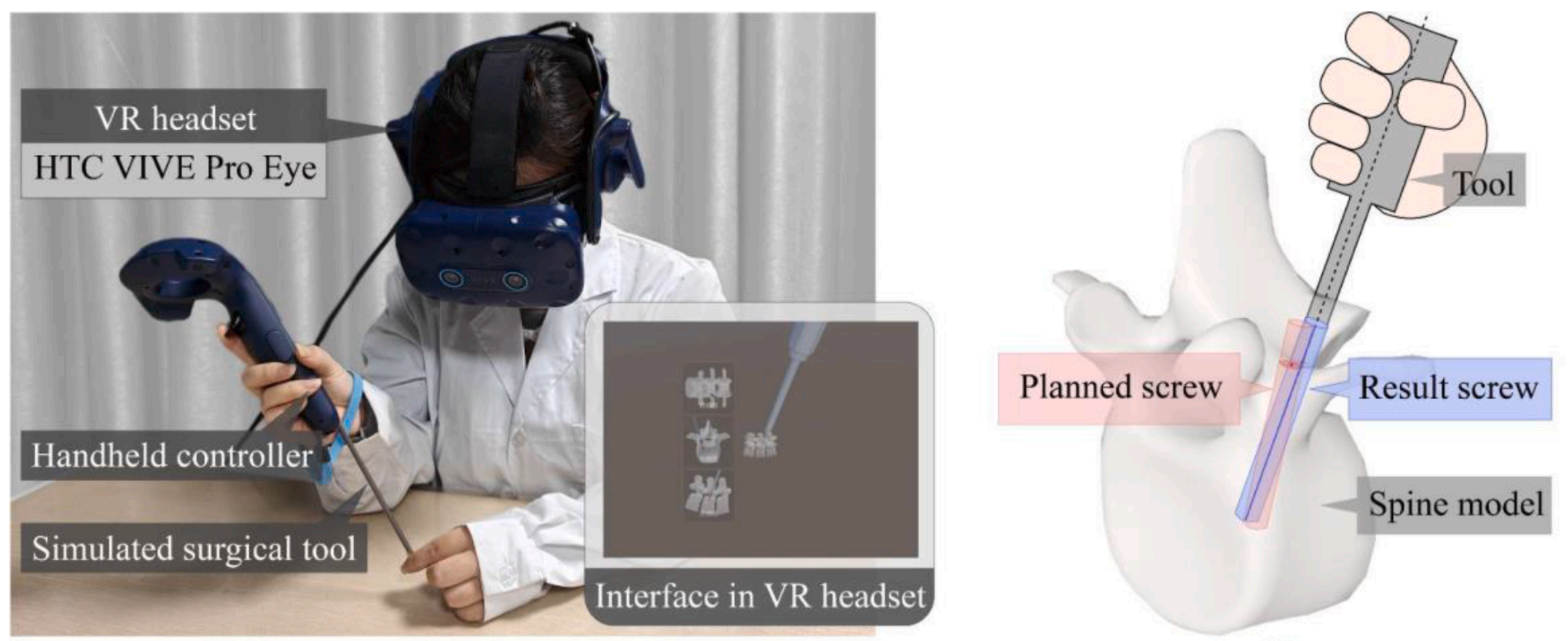
Effects of interface layouts on cognitive performance for pedicle screw placement simulator in immersive environments
This work investigates how view layout design in immersive VR affects performance in complex medical procedures such as pedicle screw placement, which require precise hand-eye coordination and multi-angle spatial understanding. Through an experiment with 27 participants, the study shows that layout choices significantly influence task efficiency and visual search behaviour, with vertically arranged views on the left reducing response time. The findings provide practical design guidelines for VR simulators that integrate manual interaction with multiple perspectives.
Publication type: full paper
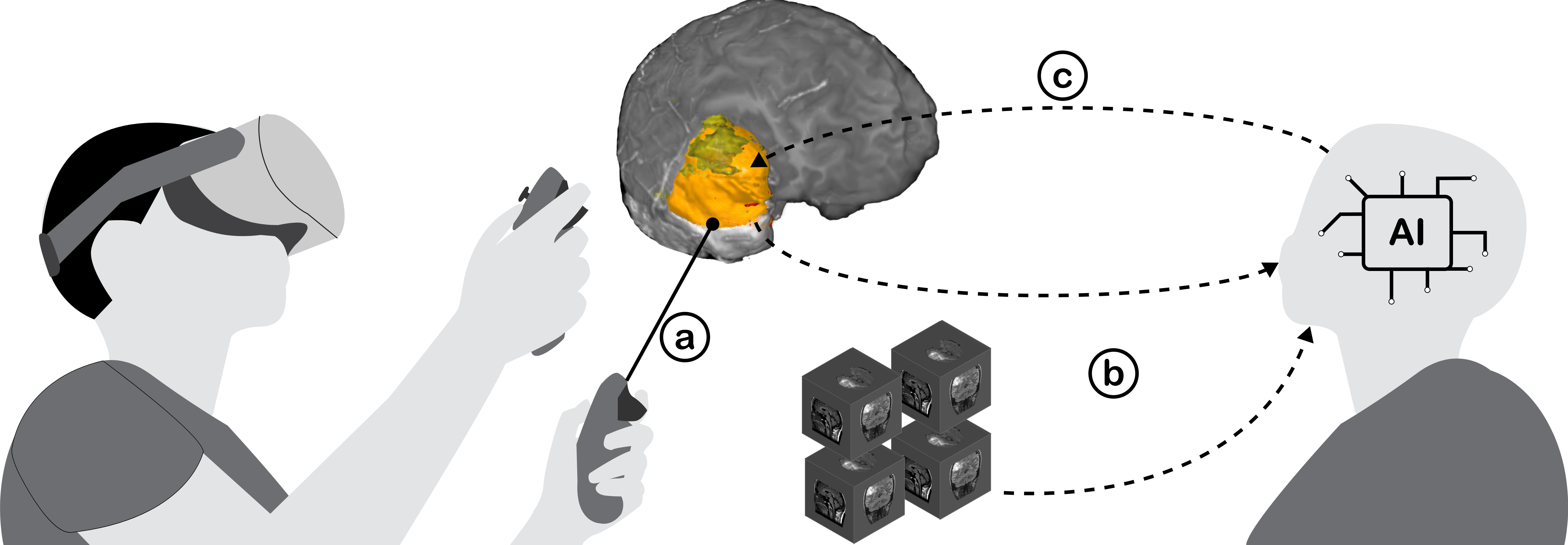
SAMMed-VR: Integrated Segment Anything Model in Virtual Reality for Supervised Brain Tumour Segmentation
In this work, we developed a design probe to explore how virtual reality can be used to integrate an expert-in-the-loop approach with SAM-Med3D for robust brain tumour segmentation. The imaging data of the brain and the segmented tumours are visualised in virtual reality, where experts can use analytical tools to review the segmentation. They can iteratively refine the results by selecting specific points for the AI to refine and improve the segmentation. In future work, we will collaborate with domain experts to evaluate and improve our prototype.
Publication type: short paper
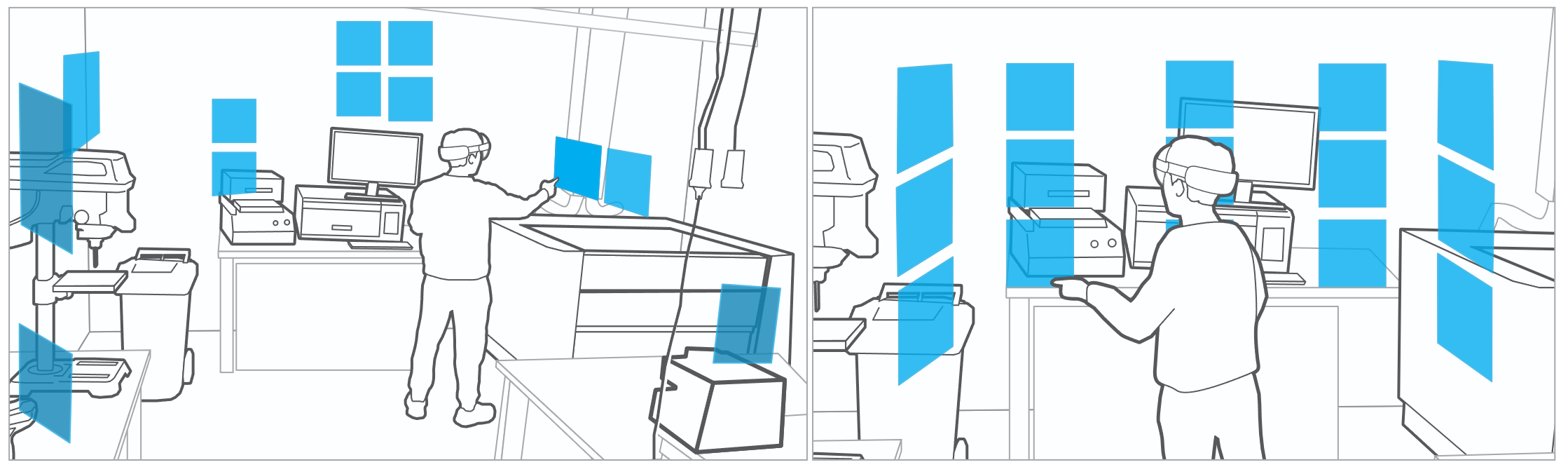
Investigating the Effects of Physical Landmarks on Spatial Memory for Information Visualisation in Augmented Reality
In this work, we provide the first AR study of spatial memory, comparing two different room settings with two different situated layouts of virtual targets on an abstract spatial memory task. We find that participants recall spatial patterns with greater accuracy and higher subjective ratings in a room with furniture compared to an empty room. Our findings lead to important design implications for mixed-reality user interfaces, particularly in information-rich applications like situated analytics and small-multiples information visualisation.
Publication type: full paper
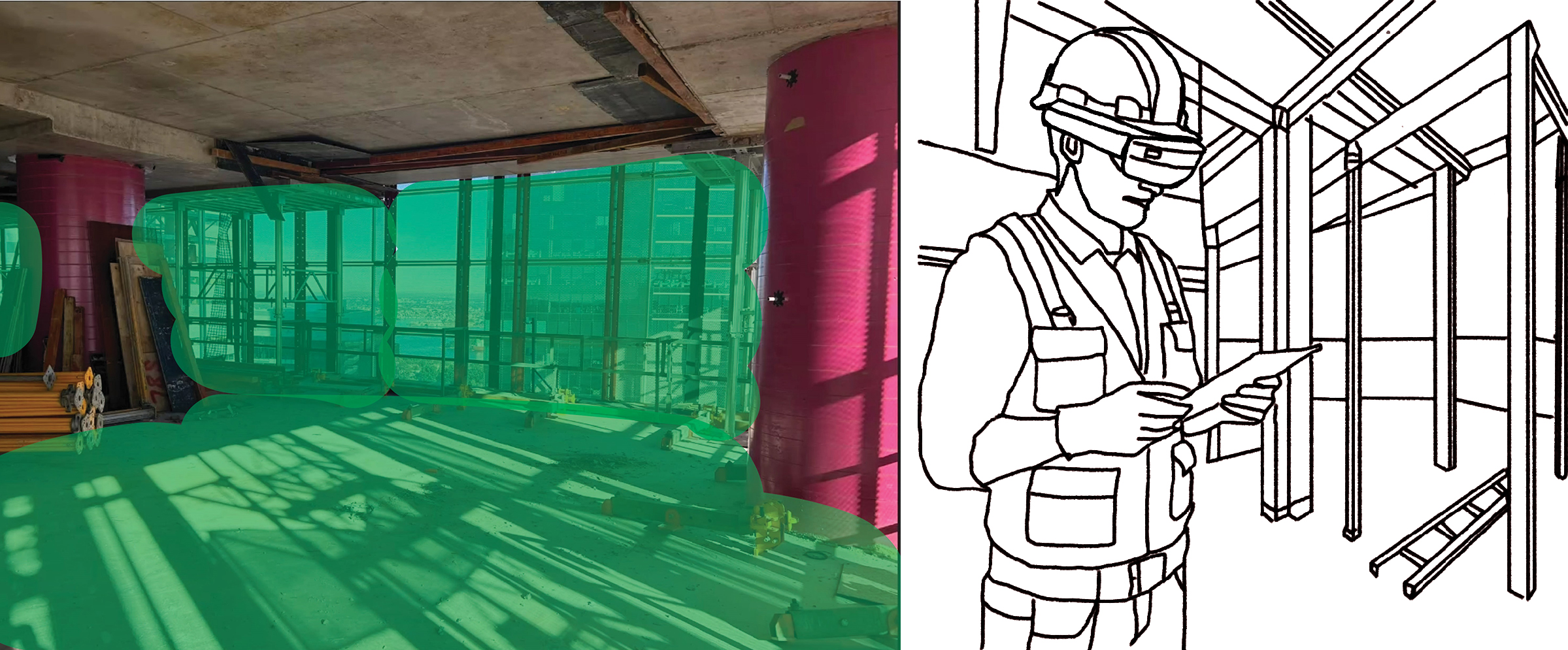
AR-Facilitated Safety Inspection and Fall Hazard Detection on Construction Sites
Together with industry experts, we are exploring the potential of head-mounted augmented reality to facilitate safety inspections on high-rise construction sites. A particular concern in the industry is inspecting perimeter safety screens on higher levels of construction sites, intended to prevent falls of people and objects. We aim to support workers performing this inspection task by tracking which parts of the safety screens have been inspected. We use machine learning to automatically detect gaps in the perimeter screens that require closer inspection and remediation and to automate reporting. This work-in-progress paper describes the problem, our early progress, concerns around worker privacy, and the possibilities to mitigate these.
Publication type: short paper
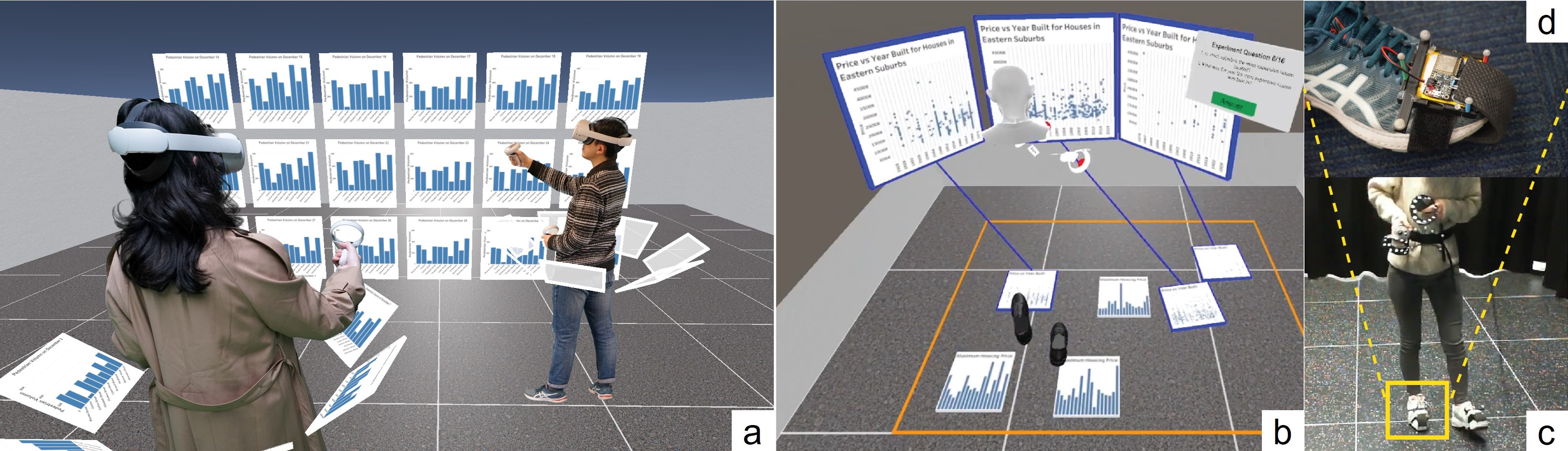
DataDancing: An Exploration of the Design Space For Visualisation View Management for 3D Surfaces and Spaces
In this work, We encapsulate the possibilities for visualisation view management into a design space (called “DataDancing”). From this design space we extrapolate a variety of view management prototypes, each demonstrating a diferent combination of interaction techniques and space use. The prototypes are enabled by a full-body tracking system including novel devices for torso and foot interaction. We explore four of these prototypes, encompassing standard wall and table-style interaction as well as novel foot interaction, in depth through a qualitative user study. Learning from the results, we improve the interaction techniques and propose two hybrid interfaces that demonstrate interaction possibilities of the design space.
Publication type: full paper

GestureExplorer: Immersive Visualisation and Exploration of Gesture Data
This paper presents the design and evaluation of GestureExplorer, an Immersive Analytics tool that supports the interactive exploration, classifcation and sensemaking with large sets of 3D temporal gesture data. GestureExplorer features 3D skeletal and trajectory visualisations of gestures combined with abstract visualisations of clustered sets of gestures. By leveraging the large immersive space aforded by a Virtual Reality interface our tool allows free navigation and control of viewing perspective for users to gain a better understanding of gestures.
Publication type: full paper
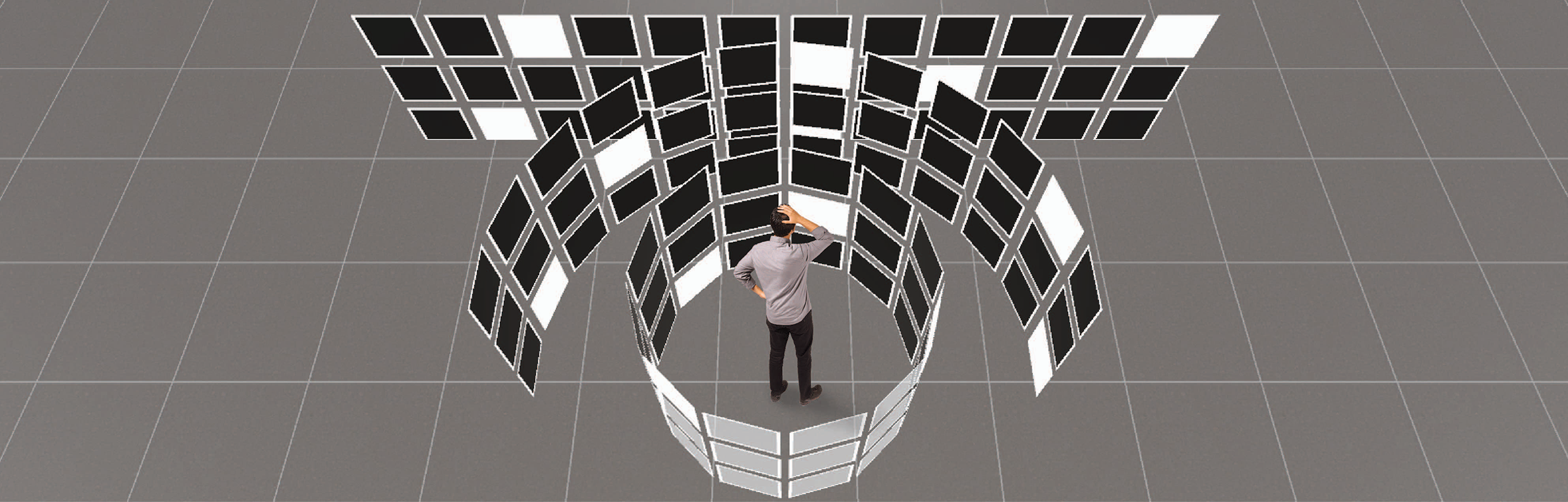
Effects of Display Layout on Spatial Memory for Immersive Environments
In this paper, we perform two user studies to evaluate the effects of three layouts with varying degrees of curvature around the user (flat-wall, semicircular-wraparound, and circular-wraparound) on a visuo-spatial memory task in a virtual environment. The results show that participants are able to recall spatial patterns with greater accuracy and report more positive subjective ratings using flat than circular-wraparound layouts. While we didn’t find any significant performance differences between the flat and semicircular-wraparound layouts, participants overwhelmingly preferred the semicircular-wraparound layout suggesting it is a good compromise between the two extremes of display curvature.
Publication type: full paper
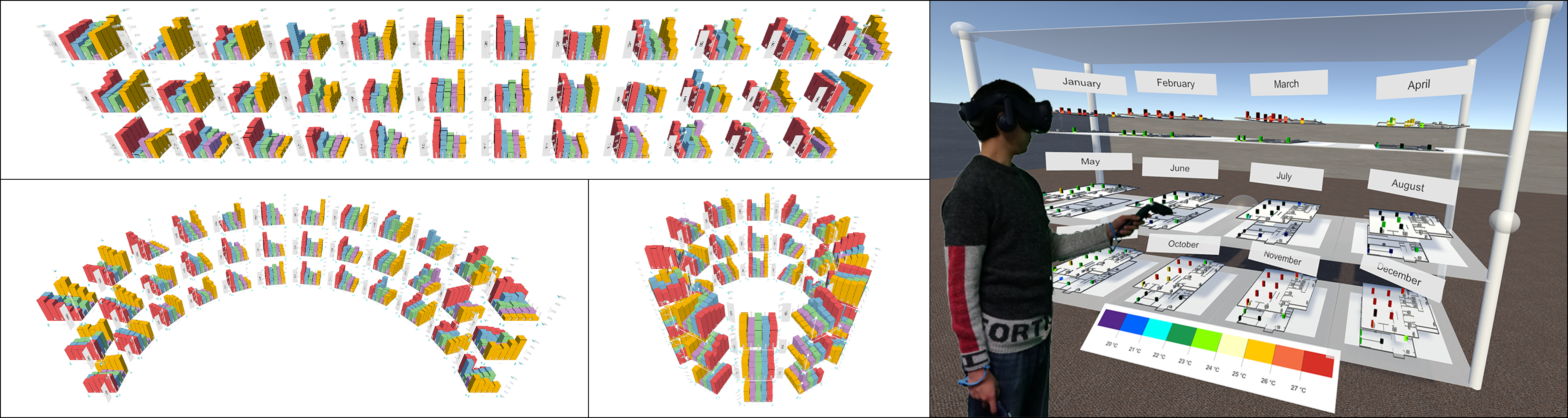
Design and evaluation of interactive small multiples data visualisation in immersive spaces
We explore the adaptation of 2D small-multiples visualisation on flat screens to 3D immersive spaces. We use a ”shelves” metaphor for layout of small multiples and consider a design space across a number of layout and interaction dimensions. We demonstrate the applicability of a prototype system informed by this design space to data sets from different domains. We perform two user studies comparing the effect of the shelf curvature dimension from our design space on users’ ability to perform comparison and trend analysis tasks. Our results suggest that, with fewer multiples, a flat layout is more performant despite the need for participants to walk further. With an increase in the number of multiples, this performance difference disappears due to the time participants had to spend walking. In the latter case, users prefer a semi-circular layout over either a fully surrounding or a flat arrangement.
Publication type: full paper