Jiazhou LiuLecturer
.01

ABOUT

PERSONAL DETAILS
Wellington Rd, Clayton VIC 3800
mapiconimg
liujiazhou@gmail.com
Hi, my name is Joe. I'm an HCI and Data Visualisation researcher.

BIO

ABOUT ME

I currently work as a Lecturer (Teaching and Research Fellow) at Embodied Visualisation (EmVis) research group, Monash University. I work with Tim Dwyer on Immersive Analytics research and with Pari Delir Haghighi on Construction Site Safety (industry-funded project). I received my PhD from the EmVis group in 2023.

I’ve been doing research in the Human-computer Interaction (HCI) field for more than 7 years. My research focuses on topics such as novel and effective interactions in immersive space, spatial cognition and perception, and AI in Immersive Analytics. I’m now leading a faculty-funded project named Automating Brain Tumour Segmentation and Visualisation using Deep Learning in Augmented Reality. I’m also working on a Building CRC project for Construction On-Site Safety via Computer Vision, Large Language Models, and Mixed Reality.

I also have six years of teaching experience at Monash University and the University of Melbourne as a lecturer, head tutor, and sessional tutor. My teaching units include Research Methods, Data Visualisation, User Interface Design and Usability, Web Fundamentals, Mobile Application Development, and Full-stack Development for both Bachelor and Master students. I have experience supervising Master's minor thesis and Bachelor’s final-year project students.

HOBBIES

INTERESTS

I started getting interested in gardening. I like caring for the flowers and plants and seeing their growth over time. It is like teaching, in which you show patience and empathy to students.

Another hobby is watching soccer games. I like C. Ronaldo. He is a perfect example of confidence and professionalism. I seldom play soccer physically, but I enjoy watching soccer matches and playing soccer video games.
.02

PUBLICATIONS

PUBLICATIONS LIST
04 Oct 2025

SAMMed-VR: Integrated Segment Anything Model in Virtual Reality for Supervised Brain Tumour Segmentation

IEEE VIS 2025


Poster/Workshop Paper/Abstract Vahid Pooryousef, Himashi Peiris, Huiyi Liang, Ang Li, Zhaolin Chen, Tim Dwyer, Jiazhou Liu,

SAMMed-VR: Integrated Segment Anything Model in Virtual Reality for Supervised Brain Tumour Segmentation

Vahid Pooryousef, Himashi Peiris, Huiyi Liang, Ang Li, Zhaolin Chen, Tim Dwyer, Jiazhou Liu,
Poster/Workshop Paper/Abstract
About The Publication
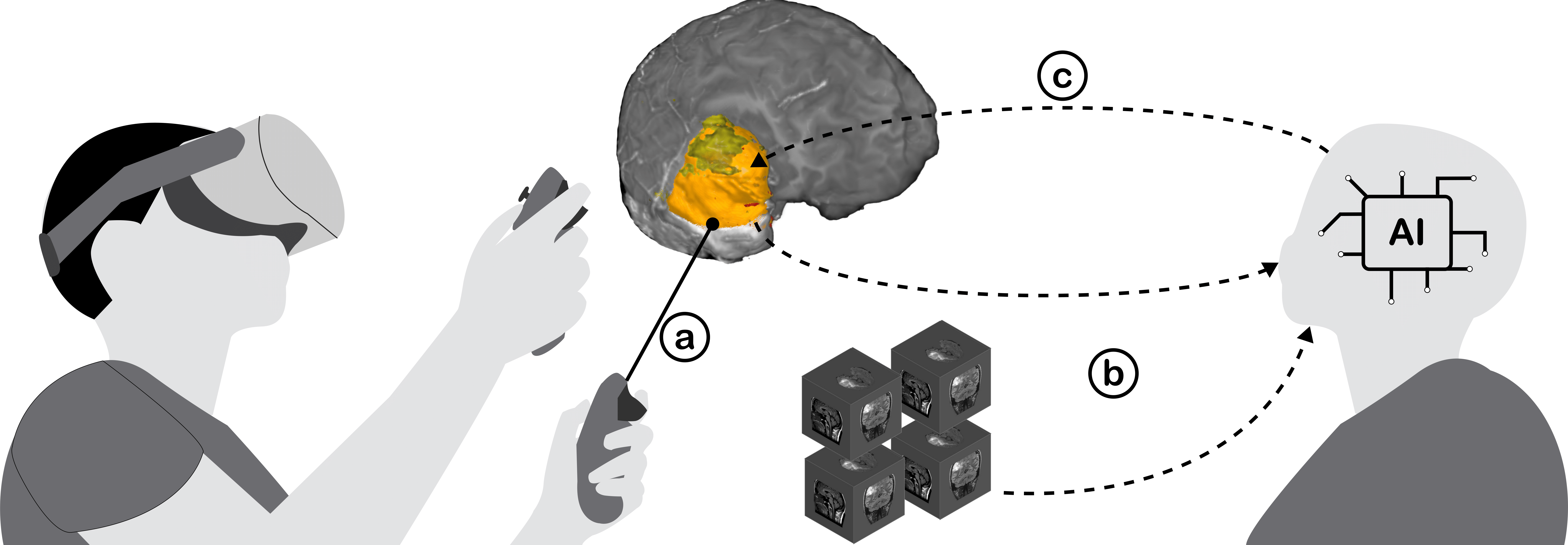
Brain tumours differ significantly in shape, size, location, and contrast imperfections. Reliable segmentation is crucial for accurate identification and effective treatment. Recent advances in AI-based 3D medical image segmentation, such as SAM-Med3D, have improved automation; however, expert supervision remains vital for brain imaging. We present a virtual reality probe that integrates an expert-in-the-loop approach with SAM-Med3D, allowing users to iteratively enhance brain tumour segmentation by selecting points for AI refinement.

The full paper preprint can be found here: PrePrint.

21 Oct 2024

AR-Facilitated Safety Inspection and Fall Hazard Detection on Construction Sites

IEEE International Symposium on Mixed and Augmented Reality Adjunct (ISMAR-Adjunct)


Poster/Workshop Paper/Abstract Selected Jiazhou Liu, Aravinda S Rao, Fucai Ke, Tim Dwyer, Benjamin Tag, Pari Delir Haghighi

AR-Facilitated Safety Inspection and Fall Hazard Detection on Construction Sites

Jiazhou Liu, Aravinda S Rao, Fucai Ke, Tim Dwyer, Benjamin Tag, Pari Delir Haghighi
Poster/Workshop Paper/Abstract Selected
About The Publication
Together with industry experts, we are exploring the potential of head-mounted augmented reality to facilitate safety inspections on high-rise construction sites. A particular concern in the industry is inspecting perimeter safety screens on higher levels of construction sites, intended to prevent falls of people and objects. We aim to support workers performing this inspection task by tracking which parts of the safety screens have been inspected. We use machine learning to automatically detect gaps in the perimeter screens that require closer inspection and remediation and to automate reporting. This work-in-progress paper describes the problem, our early progress, concerns around worker privacy, and the possibilities to mitigate these.

The full paper preprint can be found here: PrePrint.

21 Oct 2024

Investigating the Effects of Physical Landmarks on Spatial Memory for Information Visualisation in Augmented Reality

IEEE International Symposium on Mixed and Augmented Reality (ISMAR)


Conference Paper Selected Jiazhou Liu, Kadek Ananta Satriadi, Barrett Ens, Tim Dwyer

Investigating the Effects of Physical Landmarks on Spatial Memory for Information Visualisation in Augmented Reality

Jiazhou Liu, Kadek Ananta Satriadi, Barrett Ens, Tim Dwyer
Conference Paper Selected
About The Publication
Augmented Reality (AR) is touted to be beneficial in supporting situated information display, allowing virtual information panels to be overlaid on real-world scenes. People must then use their spatial memory to navigate among these virtual panels effectively. While spatial memory has been studied in physical environments (wall displays) and virtual reality environments, there has been little research on how physical surroundings might affect memorisation of virtual content in a mixed environment like AR. Therefore, we provide the first AR study of spatial memory, comparing two different room settings with two different situated layouts of virtual targets on an abstract spatial memory task. We find that participants recall spatial patterns with greater accuracy and higher subjective ratings in a room with furniture compared to an empty room. Our findings lead to important design implications for mixed-reality user interfaces, particularly in information-rich applications like situated analytics and small-multiples information visualisation.

The full paper preprint can be found here: PrePrint.

23 Apr 2023

GestureExplorer: Immersive Visualisation and Exploration of Gesture Data

ACM Conference on Human Factors in Computing Systems (CHI)


Conference Paper Ang Li, Jiazhou Liu, Maxime Cordeil, Jack Topliss, Thammathip Piumsomboon, Barrett Ens

GestureExplorer: Immersive Visualisation and Exploration of Gesture Data

Ang Li, Jiazhou Liu, Maxime Cordeil, Jack Topliss, Thammathip Piumsomboon, Barrett Ens
Conference Paper
About The Publication
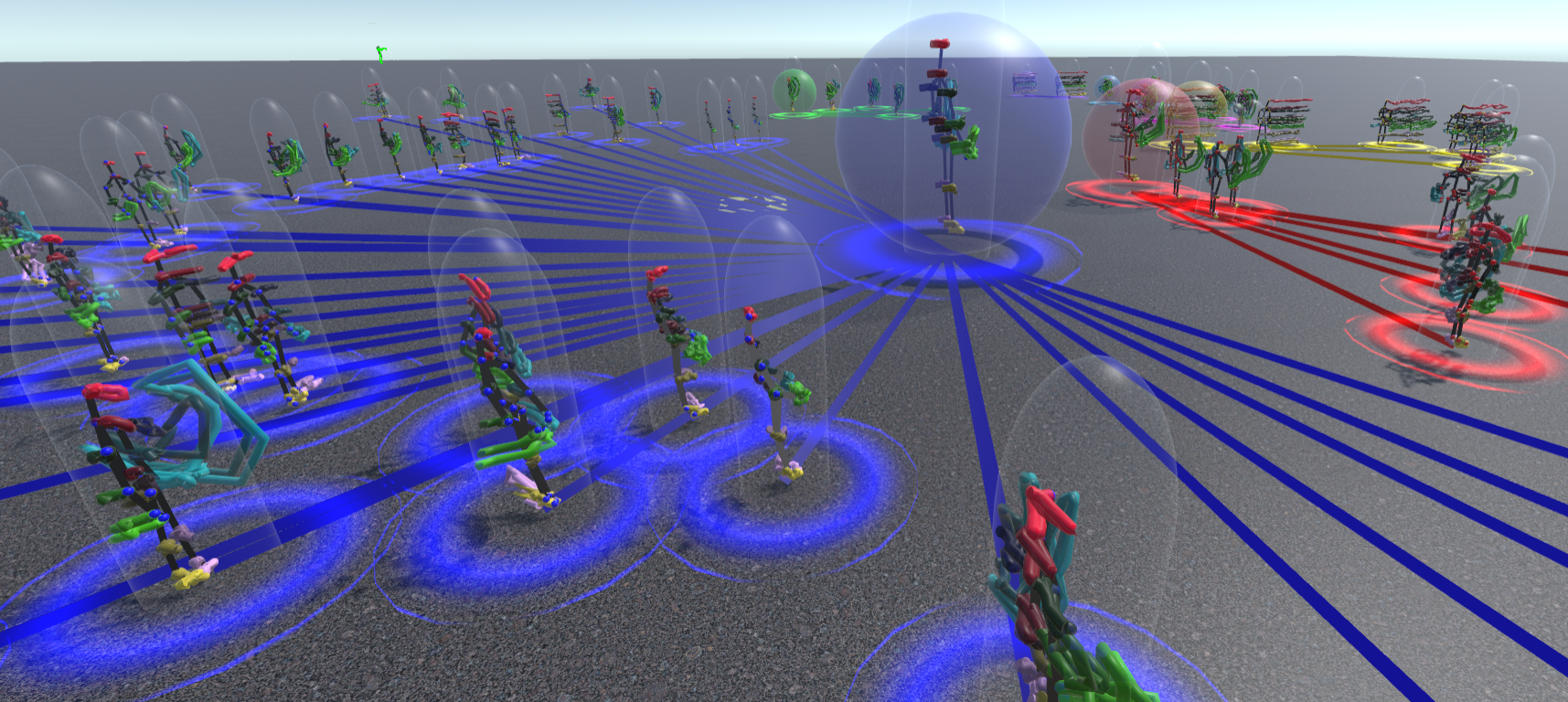
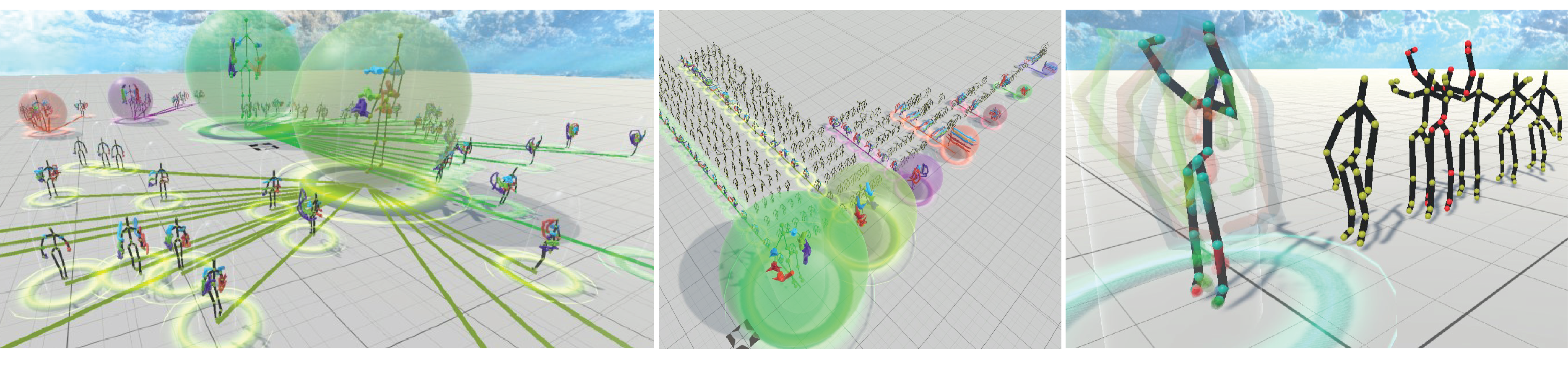
This paper presents the design and evaluation of GestureExplorer, an Immersive Analytics tool that supports the interactive exploration, classification and sensemaking with large sets of 3D temporal gesture data. GestureExplorer features 3D skeletal and trajectory visualisations of gestures combined with abstract visualisations of clustered sets of gestures. By leveraging the large immersive space afforded by a Virtual Reality interface our tool allows free navigation and control of viewing perspective for users to gain a better understanding of gestures. We explore a selection of classification methods to provide an overview of the dataset that is linked to a detailed view of the data that shows different visualisation modalities. We evaluate GestureExplorer with two user studies and collected feedback from participants with diverse visualisation and analytics backgrounds. Our results demonstrate the promising capability of GestureExplorer for providing a useful and engaging experience in exploring and analysing gesture data.

The full paper preprint can be found here: PrePrint.

23 Apr 2023

DataDancing: An Exploration of the Design Space For Visualisation View Management for 3D Surfaces and Spaces

ACM Conference on Human Factors in Computing Systems (CHI)


Conference Paper Selected Jiazhou Liu, Barrett Ens, Arnaud Prouzeau, Jim Smiley, Isobel Nixon, Sarah Goodwin, Tim Dwyer

DataDancing: An Exploration of the Design Space For Visualisation View Management for 3D Surfaces and Spaces

Jiazhou Liu, Barrett Ens, Arnaud Prouzeau, Jim Smiley, Isobel Nixon, Sarah Goodwin, Tim Dwyer
Conference Paper Selected
About The Publication
Recent studies have explored how users of immersive visualisation systems arrange data representations in the space around them. Generally, these have focused on placement centred at eye-level in absolute room coordinates. However, work in HCI exploring full-body interaction has identified zones relative to the user’s body with different roles. We encapsulate the possibilities for visualisation view management into a design space (called “DataDancing”). From this design space we extrapolate a variety of view management prototypes, each demonstrating a different combination of interaction techniques and space use. The prototypes are enabled by a full-body tracking system including novel devices for torso and foot interaction. We explore four of these prototypes, encompassing standard wall and table-style interaction as well as novel foot interaction, in depth through a qualitative user study. Learning from the results, we improve the interaction techniques and propose two hybrid interfaces that demonstrate interaction possibilities of the design space.

The full paper preprint can be found here: PrePrint.

01 Dec 2022

Effects of Display Layout on Spatial Memory for Immersive Environments

ACM Interactive Surfaces and Spaces Conference (ISS)


Conference Paper Selected Jiazhou Liu, Arnaud Prouzeau, Barrett Ens, Tim Dwyer

Effects of Display Layout on Spatial Memory for Immersive Environments

Jiazhou Liu, Arnaud Prouzeau, Barrett Ens, Tim Dwyer
Conference Paper Selected
About The Publication
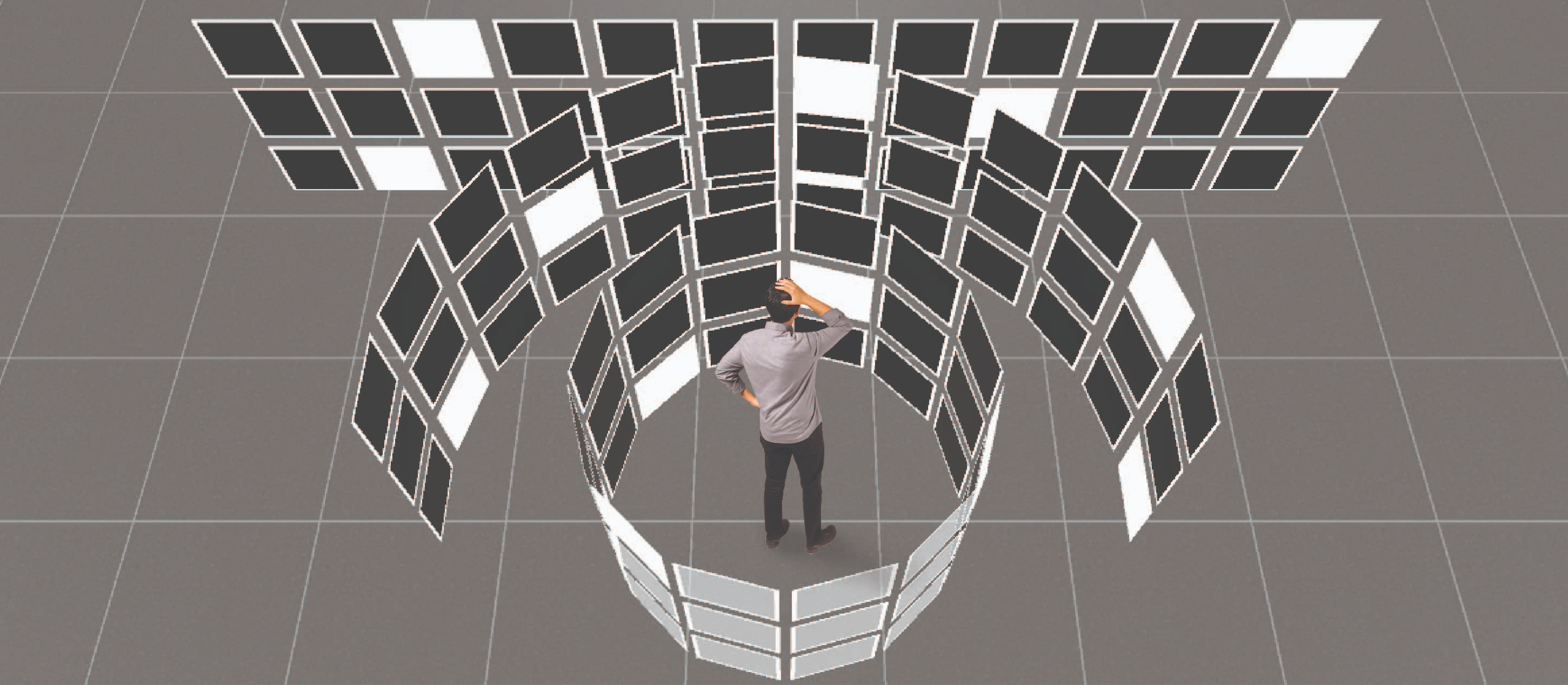
In immersive environments, positioning data visualisations around the user in a wraparound layout has been advocated as advantageous over flat arrangements more typical of traditional screens. However, other than limiting the distance users must walk, there is no clear design rationale behind this common practice, and little research on the impact of wraparound layouts on visualisation tasks. The ability to remember the spatial location of elements of visualisations within the display space is crucial to support visual analytical tasks, especially those that require users to shift their focus or perform comparisons. This ability is influenced by the user’s spatial memory but how spatial memory is affected by different display layouts remains unclear. In this paper, we perform two user studies to evaluate the effects of three layouts with varying degrees of curvature around the user (flat-wall, semicircular-wraparound, and circular-wraparound) on a visuo-spatial memory task in a virtual environment. The results show that participants are able to recall spatial patterns with greater accuracy and report more positive subjective ratings using flat than circular-wraparound layouts. While we didn’t find any significant performance differences between the flat and semicircular-wraparound layouts, participants overwhelmingly preferred the semicircular-wraparound layout suggesting it is a good compromise between the two extremes of display curvature.

The full paper preprint can be found here: PrePrint.

12 Mar 2022

Initial Evaluation of Immersive Gesture Exploration with GestureExplorer

IEEE Conference on Virtual Reality and 3D User Interfaces Abstracts and Workshops (VR)

GestureExplorer

Poster/Workshop Paper/Abstract Ang Li, Jiazhou Liu, Max Cordeil, Barrett Ens

Initial Evaluation of Immersive Gesture Exploration with GestureExplorer

Ang Li, Jiazhou Liu, Max Cordeil, Barrett Ens
Poster/Workshop Paper/Abstract
About The Publication
This paper presents GestureExplorer, which features versatile immersive visualisations to grant the user free control over their perspective, allowing them to gain a better understanding of gestures. It provides multiple data visualisation views, and interactive features to support analysis and exploration of gesture datasets. A pair of iterative user studies provides initial feedback from several participants, including experts on immersive visualisation, and demonstrates the potential of GestureExplorer for providing a useful and engaging experience for exploring gesture data. The full poster preprint can be found here: PrePrint.
03 Sep 2021

Embodied gesture interaction for immersive maps

Cartography and Geographic Information Science

GestureMap

Journal Paper Rhys Newbury, Kadek Ananta Satriadi, Jesse Bolton, Jiazhou Liu, Maxime Cordeil, Arnaud Prouzeau, Bernhard Jenny

Embodied gesture interaction for immersive maps

Rhys Newbury, Kadek Ananta Satriadi, Jesse Bolton, Jiazhou Liu, Maxime Cordeil, Arnaud Prouzeau, Bernhard Jenny
Journal Paper
About The Publication
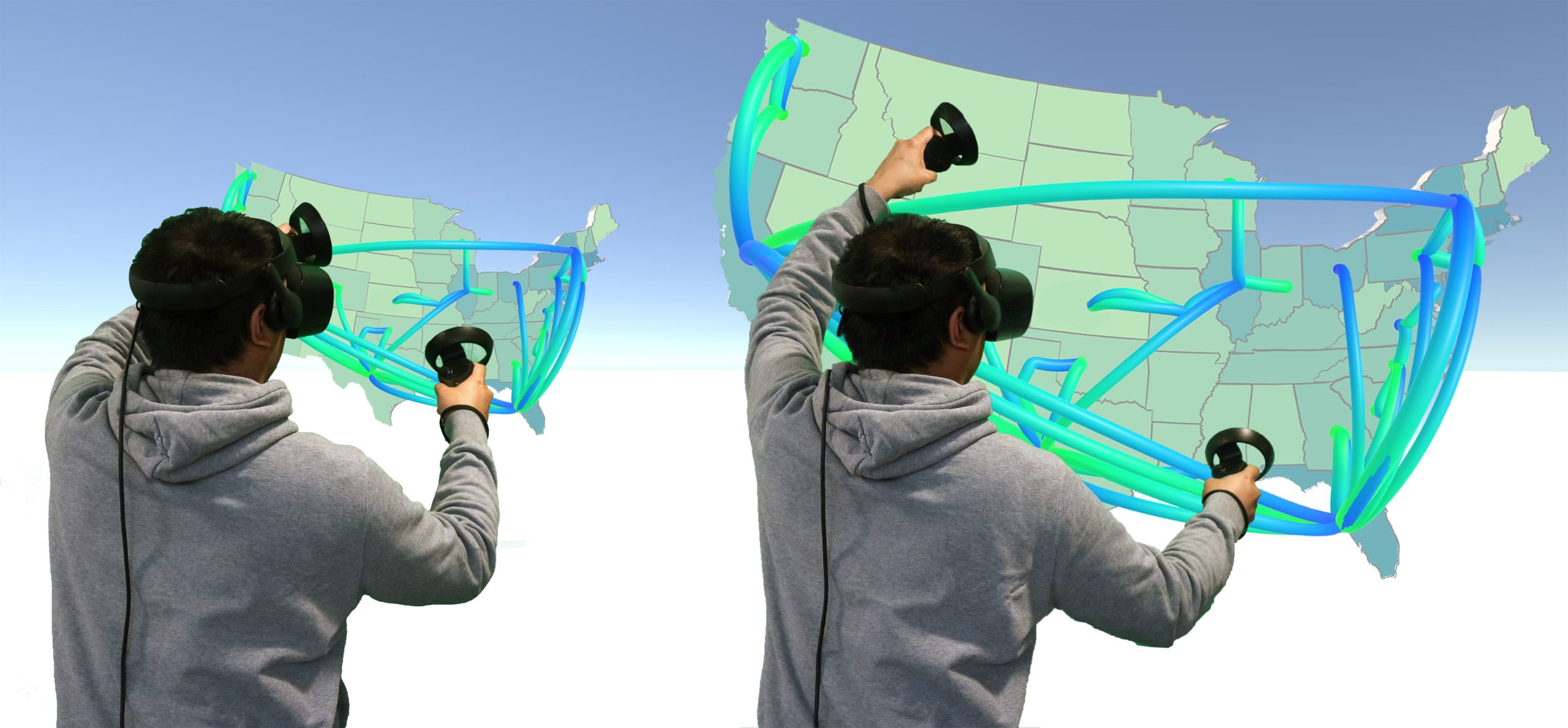
With the increasing availability of head-mounted displays for virtual reality and augmented reality, we can create immersive maps in which the user is closer to the data. Embodiment is a key concept, allowing the user to act upon virtual objects in an immersive environment. Our work explores the use of embodied interaction for immersive maps. We propose four design considerations for embodied maps and embodied gesture interaction with immersive maps: object presence, consistent physics, human body skills, and direct manipulation. We present an example of an immersive flow map with a series of novel embodied gesture interactions, which adhere to the proposed design considerations. The embodied interactions allow users to directly manipulate immersive flow maps and explore origin-destination flow data in novel ways. Authors of immersive maps can use the four proposed design considerations for creating embodied gesture interactions. The discussed example interactions apply to diverse types of immersive maps and will hopefully incite others to invent more embodied interactions for immersive maps. The full paper preprint can be found here: PrePrint.
22 Mar 2020

Design and evaluation of interactive small multiples data visualisation in immersive spaces

IEEE Conference on Virtual Reality and 3D User Interfaces (VR)


Conference Paper Selected Jiazhou Liu, Arnaud Prouzeau, Barrett Ens, Tim Dwyer

Design and evaluation of interactive small multiples data visualisation in immersive spaces

Jiazhou Liu, Arnaud Prouzeau, Barrett Ens, Tim Dwyer
Conference Paper Selected
About The Publication
Nominated as Best Paper Award.
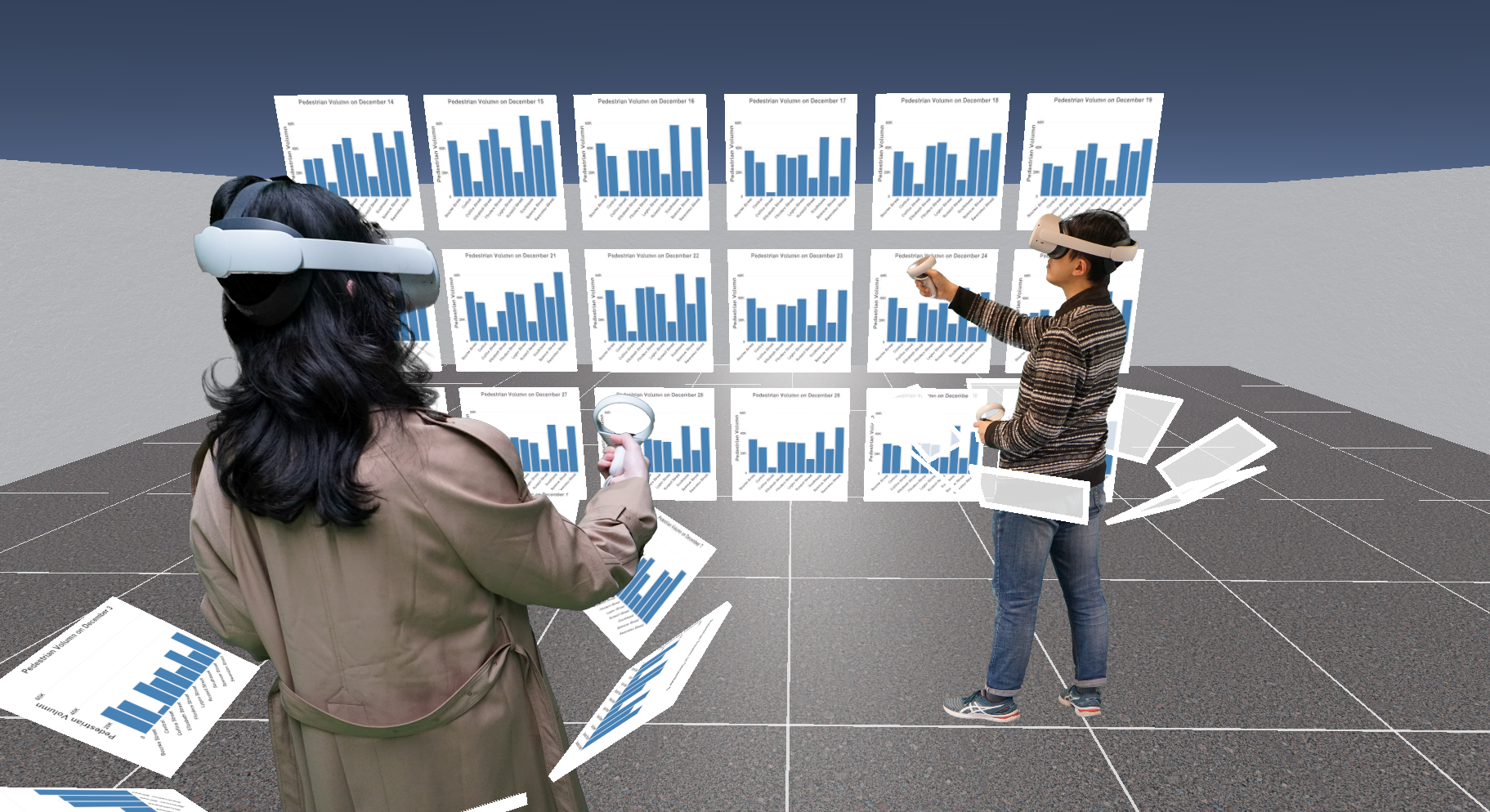
We explore the adaptation of 2D small-multiples visualisation on flat screens to 3D immersive spaces. We use a ”shelves” metaphor for layout of small multiples and consider a design space across a number of layout and interaction dimensions. We demonstrate the applicability of a prototype system informed by this design space to data sets from different domains. We perform two user studies comparing the effect of the shelf curvature dimension from our design space on users’ ability to perform comparison and trend analysis tasks. Our results suggest that, with fewer multiples, a flat layout is more performant despite the need for participants to walk further. With an increase in the number of multiples, this performance difference disappears due to the time participants had to spend walking. In the latter case, users prefer a semi-circular layout over either a fully surrounding or a flat arrangement. The full paper preprint can be found here: PrePrint.
.03

RESUME

EDUCATION
  • 2019
    2023
    Melbourne

    Doctor of Philosophy

    Data Visualisation and Immersive Analytics Lab, Monash University

    Thesis:
    Immersive View Management for Interactive Data Visualisation
    Main Supervisor: Prof. Tim Dwyer (Monash University)
    Assoc. Supervisors: A/Prof. Barrett Ens (UBC, Canada), Dr Arnaud Prouzeau (Inria, France)
  • 2017
    2019
    Melbourne

    Master of Information Technology

    Monash University

    Minor Thesis:
    Small Multiple Visualisation for BIM Data in the Immersive Environment
    Main Supervisor: Prof. Tim Dwyer (Monash University)
    Assoc. Supervisors: Dr Barrett Ens (UBC, Canada), Dr Arnaud Prouzeau (Inria, France)
  • 2009
    2013
    Sydney

    Bachelor of Science (BSc): Computer Science

    University of New South Wales

    Major in networking. Also interested in web design and application development.
Grants, Scholarships & Awards
  • 2024
    2025
    Melbourne

    Monash FIT ECA Seed Grant

    Monash University

    The Early Career Academics (ECA) Seed Grant scheme supports projects with budgets up to $10,000 (individual) or $35,000 (teams) and applications may be submitted by ECAs within the Faculty. The purpose of the scheme is to seed impact, interdisciplinary collaboration and visibility.
  • 2022
    2022
    Melbourne

    Postgraduate Publication Award

    Monash University

    The Postgraduate Publications Award (PPA) funds high-achieving students with sharing their research findings with the wider public through publishing in professional journals or books.
  • 2022
    2022
    Melbourne

    Faculty Graduate Research Completion Award

    Monash University

    The award was temporarily introduced to support those close to submitting their thesis and who have experienced an immediate and exceptional impact resulting from COVID-19.
  • 2019
    2022
    Melbourne

    Australian Research Training Program Scholarship

    Australian Department of Education

    A scholarship award by the Australian Department of Education for my PhD tuition fees and a stipend for my general living costs.
  • 2018
    2019
    Melbourne

    Information Technology Postgraduate Scholarship

    Monash University

    A scholarship award by Monash for continuing students studying for a postgraduate degree in Information Technology.
Academic Services
  • Conference Committee

    2025: iiWAS/MoMM - PC Member
    2024: IEEE ISMAR - Web Chair
    2023: ISMAR - Web Chair
  • Paper Review

    2025: ACM CHI, IEEE ISMAR, IEEE VR
    2024: ACM CHI, IEEE VIS
    2023: ACM CHI
    2022: ACM ISS
    2021: IEEE VR, ACM ISS
    2020: ACM CHI LBW
  • Workshop Organiser

    2022: ACM CHI
    2021: Monash Take CTRL
  • Student Volunteer

    2022: IEEE VIS
    2021: IEEE VIS
    2020: ACM CHI
Talks and Presentations
  • Paper Presentations

    2022: ACM ISS Conference at Wellington, New Zealand
    2020: IEEE VR Conference Online
  • Workshop Presentation

    2021: Monash Take CTRL
  • Guest Presentation

    2022: Monash FIT3179 Data Visualisation
    2021: Monash FIT5147 Data Visualisation
    2020: Monash FIT5147 Data Visualisation
    2019: Monash FIT5147 Data Visualisation
.04

RESEARCH

DISCIPLINE GROUP TEAM

Tim Dwyer

Professor

Pari Delir Haghighi

Senior Lecturer

Kadek Ananta Satriadi

Lecturer

Bernhard Jenny

Associate Professor

Sarah Goodwin

Senior Lecturer

RESEARCH PROJECTS

Automating Brain Tumor Segmentation and Visualization Using a Deep Learning Approach in Immersive Environments

Researchers: Jiazhou Liu, Himashi Peiris, Vahid Pooryousef, Mia Liang, Ang Li, Tim Dwyer

We propose a Deep-Learning-based approach for automated brain tumor segmentation inspired by recent Vision Foundational Models (VFM) such as the Segment Anything Model (SAM). The output data from this approach will then be processed by an advanced visualization engine and displayed via immersive technologies (i.e., Augmented Reality) for natural interactions with 3D volume data. This project aims to address the limitations of conventional methods for brain tumor segmentation which require manual intervention for interpreting medical scans, by developing an advanced visualization system integrated with a prompt-driven AI model, leading to more informed decision-making in diagnosis and treatment planning.

Immersive Geovisualisation: Visualising geospatial data with virtual reality and augmented reality

Researchers: Bernie Jenny, Zeinab Ghaemi, Sarah Goodwin, Barrett Ens, Jiazhou Liu, Benjamin Lee, Kadek Ananta Satriadi (UniSA), Kurtis Danyluk (University of Calgary), Wesley Willett (University of Calgary), Maxime Cordeil (University of Queensland), Tobias Czauderna (Hochschule Mittweida)

In immersive environments, positioning data visualisations around the user in a wraparound layout has been advocated as advantageous over flat arrangements more typical of traditional screens. However, other than limiting the distance users must walk, there is no clear design rationale behind this common practice and little research on the impact of wraparound layouts on visualisation tasks. The ability to remember the spatial location of elements of visualisations within the display space is crucial to support visual analytical tasks, especially those that require users to shift their focus or perform comparisons. The user's spatial memory influences this ability, but how spatial memory is affected by different display layouts remains unclear. What are the most intuitive and least fatiguing ways to interact with maps in virtual reality and augmented reality? How do we best zoom and move virtual maps? How can we use virtual maps outdoors? And how can we place virtual bar charts and other diagrams in the real world? We explore these and many similar questions related to immersive geovisualization, an exciting new field focusing on the visualisation of spatial data with virtual reality and augmented reality indoors and outdoors.

Investigating Data Visualisation Layout and Placement Strategies on Spatial Memory in Augmented Reality

Researchers: Jiazhou Liu, Arnaud Prouzeau (Inria), Barrett Ens (UBC), Tim Dwyer

Previous research explored the layout effect on spatial memory in the Virtual Reality environment using an abstract task. The results show that a flat layout performs better than a circular wrap-around layout. In this research, we aim to explore whether such an effect remains significant in an Augmented Reality environment, where 2D visualisations are overlaid directly on their surroundings, and users can use features in the physical working environment as spatial landmarks.

GestureExplorer: Immersive Visualisation and Exploration of Gesture Data

Researchers: Ang Li, Jiazhou Liu, Max Cordeil, Barrett Ens

Gesture elicitation studies are a popular means for researchers to design and explore user-preferred gestures. Motivated by the need to investigate large gesture data sets and incorporate automated analysis tools, researchers have introduced systems that support visualisation and human-in-the-loop exploration of Spatio-temporal gesture data. However, these tools have until now been limited to 2D projections of gestures performed in 3D space. Immersive Analytics offers new opportunities to support a more intuitive visualisation of gesture data by allowing the user to move around a set of spatially-visualised 3D views. This paper presents GestureExplorer, which features versatile immersive visualisations to grant the user free control over their perspective, allowing them to gain a better understanding of gestures. It provides multiple data visualisation views and interactive features to support the analysis and exploration of gesture datasets. A pair of iterative user studies provide initial feedback from several participants, including experts on immersive visualisation, and demonstrates the potential of GestureExplorer for providing a valuable and engaging experience for exploring gesture data.

Visualisation View Management for 3D Surfaces and Spaces

Researchers: Jiazhou Liu, Jim Smiley, Barrett Ens (UBC), Arnaud Prouzeau (Inria & LaBRI), Sarah Goodwin, Tim Dwyer

Recent studies have explored how users of immersive visualisation systems arrange data representations in the space around them. Generally, the data exploration tasks tested in these studies have focused on the static placement of visualisations centred at eye level in absolute room coordinates. However, more general work in HCI exploring proxemic interaction has identified zones relative to the user's body with different roles. Nevertheless, modern optical tracking systems are available that support tracking of any part of the body, enabling additional zones for interactions such as foot interaction on floor-referenced displays. This project aims to explore the design space for visualisation view management for 3D surfaces and spaces, focusing on the space around the users. The research outcomes include: (1) a vast design space for visualisation view management in 3D space, (2) a design consideration for both presentation of and interaction with visualisation views in 3D spaces, and (3) an exploratory study to evaluate the design considerations, and (4) guidelines for future research and systems on visualisation view management in 3D surfaces and space.

Interactive Small Multiples Data Visualisation in Immersive Spaces

Researchers: Jiazhou Liu, Arnaud Prouzeau (Inria), Barrett Ens, Tim Dwyer

Immersive technologies bring opportunities for allowing immersive data visualisation to be situated in the context of other activities. However, it also presents interaction design challenges in translating everything we have learned about visualisation design on flat screens to the spaces around us. This research project aims to explore adapting 2D small multiples visualisation on flat screens to 3D immersive spaces. We focus on the layout presentation and interaction with small multiples in immersive spaces. The primary research objectives are: (1) to identify a design space for the layout of and interaction with small multiples in a VR environment, (2) to implement various interaction techniques for interactive small multiples, and (3) to evaluate the efficiency of various small multiples layout strategies in a VR environment, and (4) understand how spatial memory is supported by different display layouts within the small multiples technique.
.05

TEACHING

CURRENT
  • 2024
    Present

    Lecturer/Chief Examiner

    Monash University

    FIT2095 Full-stack Development
    Non-B2B e-Business applications are now mostly developed for Web and mobile platforms. With the advent of mobile Web apps a set of technologies and techniques has emerged that are shared by both Web and mobile application development. This unit introduces, explains and uses these technologies and techniques to build basic but industrial strength e-Business applications. The topics covered will be selected from the following: an overview of the current state-of-play in e-Business application development, HTML5 (the living standard), CSS3, object oriented JavaScript for large developments, JavaScript APIs, Ajax, JSON, XML and related W3C technologies, jQuery, jQuery Mobile, MVC, ASP.NET MVC, ECMAScript 2015 and beyond, Angular, TypeScript, React. The appropriateness of the selected technologies in different contexts, together with relevant best practice techniques for their use and integration will also be covered.
TEACHING HISTORY
  • 2024
    Present

    Lecturer

    Monash University

    FIT2081 Mobile Development
    This unit introduces an industrial strength programming language (with supporting software technologies and standards) and object-oriented application development in the context of mobile application development for smartphones and tablets. The approach is strictly application driven. You will learn the syntax and semantics of the chosen language and its supporting technologies and standards and object oriented design and coding techniques by analysing a sequence of carefully graded, finished applications. You will also design and build your own applications.
  • 2024
    2024

    Lecturer

    Monash University

    FIT1050 Web Fundamentals
    The world-wide web is one of the most widely-used platforms for building applications. Although all students can be assumed to be experienced users of the web, very few have any clear understanding of the technologies upon which the web is based, and the way in which these technologies affect web-based applications. This unit aims to give students a sound basic knowledge of the web and a range of issues which may be involved in web application development. It will take a strongly practical focus in examining the technology, design and implementation problems a developer needs to address in developing applications for real-world systems. The diversity of web applications means that there are a wide range of issues which may be relevant to the development of any given web site. The unit will aim to give breadth of coverage of these issues, rather than focusing in depth on any particular development task or any specific type of web application.
  • 2024
    2024

    Teaching Associate

    University of Melbourne

    COMP90044 Research Method
    Research is a process of acquiring new knowledge by systematically and rigorously applying methods to address well-formulated questions. To be valuable, new knowledge must address a significant theoretical question, it must be supported by evidence and be able to stand up to critical scrutiny, and its presentation to other researchers and/or to the public must be persuasive. This subject is an introduction to research thinking, skills and methodologies as they apply to computing and related disciplines. The subject will foster the development of critical thinking, a sceptical and rigorous approach, and awareness of research ethics. This subject will be particularly useful for students contemplating undertaking a research degree, or for students currently enrolled in a research degree (MPhil or PhD) or a course-work degree with a research project (MIT, MIS).
  • 2020
    2023

    Teaching Associate (Head Tutor)

    Monash University

    FIT3179 Data Visualisation
    This unit introduces the main kinds of information graphics and interactive visualisation systems and their areas of application. It investigates the reasons why visualisation can be effective and based on this students will gain experience in critically assessing data visualisations and in designing their own visualisations.
  • 2022
    2022

    Teaching Associate

    Monash University

    FIT5147 Data Exploration and Visualisation
    This unit introduces statistical and visualisation techniques for the exploratory analysis of data. It will cover the role of data visualisation in data science and its limitations. Visualisation of qualitative, quantitative, temporal and spatial data will be presented. What makes an effective data visualisation, interactive data visualisation, and creating data visualisations with R and other tools will also be presented.
  • 2021
    2022

    Supervisor

    Monash University

    FIT3161/2 Computer Science Project
    This unit provides practical experience in researching, designing, developing and testing a substantial computer science project. Projects are generally software-based, although sometimes they may involve hardware development or investigation of theory. Projects cover the whole process of software (or hardware) development, from analysis through design to implementation and testing. Comprehensive written documentation on the project is required.
  • 2022
    2022

    Teaching Associate

    Monash University

    FIT3175 Usability
    This unit explores the underpinning theories, principles and practices of interface design to achieve usable computer-based systems. It examines issues in the design of system interfaces from a number of perspectives: user, programmer, designer. It explores the application of the relevant theories in practice. The unit will cover topics such as methods and tools for developing effective user interfaces, evaluation methods such as the conduct of usability and heuristic evaluations, design of appropriate interface elements including the design of menus and other interaction styles. The unit will also focus on designing for a diverse range of users and environments.
  • 2021
    2021

    Teaching Associate

    Monash University

    FIT5152 User interface design and usability
    This unit provides detailed understanding of user interaction design theories, principles and practices and usability for web based systems and small screen devices. The unit examines issues in interaction design and usability from various perspectives, in particular the user experience. The unit includes how to achieve more effective design during systems development, tools and techniques for understanding users better and the application of these to designing web and small screen device systems. It explores contemporary issues including the challenges faced by designers with emerging technologies.
.06

CONTACT

Contact Information

Feel free to meet me on campus at: Office 1.04, 25 Exhibition Walk (Information Technology Building 63), Clayton 3168, VIC, Australia

Monash University, Faculty of Information Technology