
Behavioural Skills Training System for Emergency Services Workers
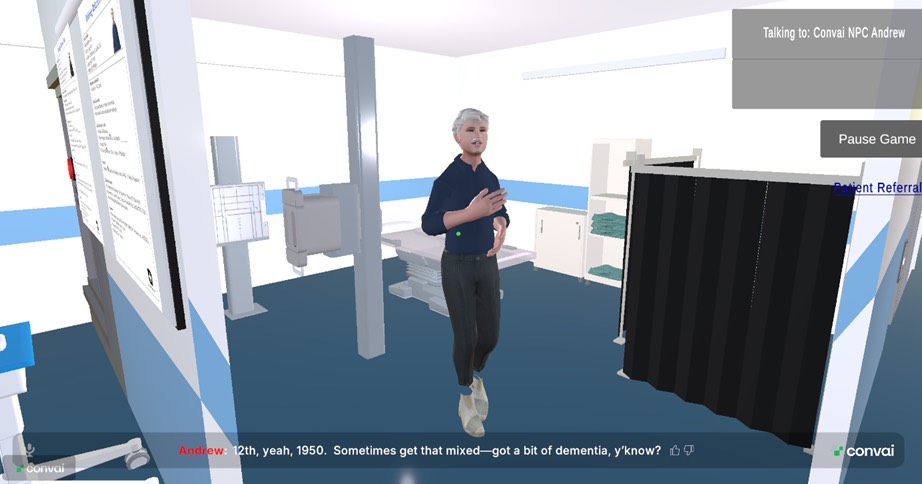
The Behavioural Skills Training System (BSTS) project explores how conversational AI and virtual reality (VR) can enhance behavioural and communication training for emergency services workers, including undergraduate paramedic students, nurses, and first responders. These professionals require frequent, low-risk opportunities to practise de-escalation, patient interaction, and team communication in high-stress, time-critical scenarios. However, traditional simulation training is resource-intensive, difficult to scale, and often constrained in realism, availability, and repeatability. BSTS extends a proven laptop-based prototype into an embodied VR environment, where users engage with AI-driven virtual patients, bystanders, and team members that respond dynamically through voice, gesture, and movement, enabling more immersive and context-rich training experiences.
A key component of the project is a co-design methodology, where researchers collaborate closely with educators, clinicians, and emergency service professionals to ensure that scenarios, behaviours, and interaction patterns reflect real-world practice. Through iterative workshops, scenario prototyping, and user testing, the system is shaped by domain expertise, aligning the AI’s conversational responses and behavioural cues with authentic clinical and field conditions. This approach supports the development of flexible virtual personas that vary in tone, emotional state, cultural background, and level of resistance, enabling adaptive role-play across a wide range of emergency contexts, such as trauma response, mental health crises, and multi-agency coordination.
Simulation-based training plays a critical role in preparing emergency service workers, as it allows learners to develop both technical and non-technical skills—such as communication, empathy, situational awareness, and decision-making—without risk to real patients. BSTS builds on this by increasing the accessibility and frequency of training opportunities, particularly for regional and remote learners and distributed teams who may have limited access to physical simulation facilities. Educators can supervise sessions in real time or review interactions through secure recordings, performance analytics, and behavioural metrics, strengthening feedback loops and enabling more personalised learning pathways.
The potential impact of BSTS lies in its ability to transform how behavioural skills are taught and assessed in emergency services education. By integrating conversational intelligence with immersive embodiment, the system offers scalable, repeatable, and authentic training experiences that can complement existing curricula and reduce reliance on resource-intensive simulations. In the longer term, such systems could support continuous professional development, standardised assessment of communication competencies, and more resilient workforce training. Ultimately, BSTS aims to improve not only learner confidence and competence, but also the quality of patient care and safety outcomes in high-pressure, real-world environments.
Project Start Year
2025
Project Collaborators
- Monash Digital Health Research Group: Prof. Chris Bain
- Monash Embodied Visualisation Research Group: Prof. Tim Dwyer
- Monash Department of Paramedicine: Prof. Brendan Shannon
- Monash School of Clinical Sciences: Marijke Mitchell
- Monash School of Nursing and Midwifery: Trung Minh Nguyen
Student Project
- Design and Evaluation of a VR-Based Behavioural Skills Training System for Nursing Students
- Ongoing Monash Advanced CS Research Project.