
ProDAIS: GenAI-Facilitated Collaborative Learning System for Productive Group Discussion in Information Technology Education
Group discussion plays an essential role in learning processes, enabling students to exchange ideas, negotiate meaning, and co-construct knowledge through interaction. However, sustaining such productive interaction remains a persistent challenge. Students often experience regulatory breakdowns in how they manage participation, focus, and reflection. For example, uneven participation, topic drift, and limited joint review of progress, which hinder shared reasoning and collective outcomes.
Recent advances in Generative AI (GenAI) offer new opportunities to augment these processes, not by replacing human facilitator, but by acting as a low-interference regulatory partner to support group discussion in real time. To explore this potential, the present study adopted a Design-Based Research (DBR) approach consisting of two phases. Phase 1 involved semi-structured interviews with 15 Information Technology (IT) students to examine their collaborative experiences and expectations of AI support. The findings revealed that students prioritised support for the often invisible conditions of collaboration (e.g., pacing and participation equity) rather than content generation.
Guided by these needs, we developed Productive Discussion AI System (ProDAIS), a lightweight GenAI facilitator designed to support the Four Goals of Productive Discussions (FGPDs). ProDAIS integrates Socially Shared Regulation of Learning (SSRL) to determine when and why to intervene (e.g., regulating participation balance), and Academically Productive Talk (APT) to determine what and how to intervene through non-evaluative, inviting talk moves.
In Phase 2, the study focused on the iterative design and evaluation of ProDAIS through a user study, examining perceived usability (System Usability Scale, SUS), cognitive load (NASA-TLX), and students’ perceived support toward the FGPDs goals. Results indicate high perceived usability (SUS score: 78.5), low cognitive load, and consistent perceived support for participation balance and time management. Overall, the findings suggest that ProDAIS demonstrates how GenAI can facilitate productive group discussion by making participation balance and pacing visible.
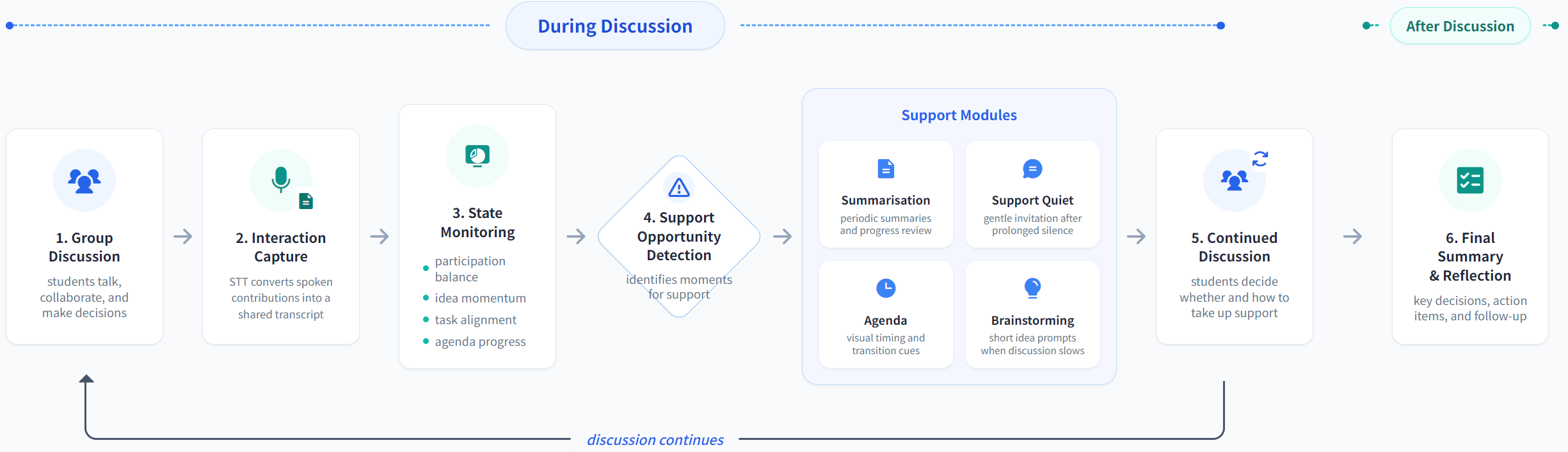
Figure 1: System Workflow
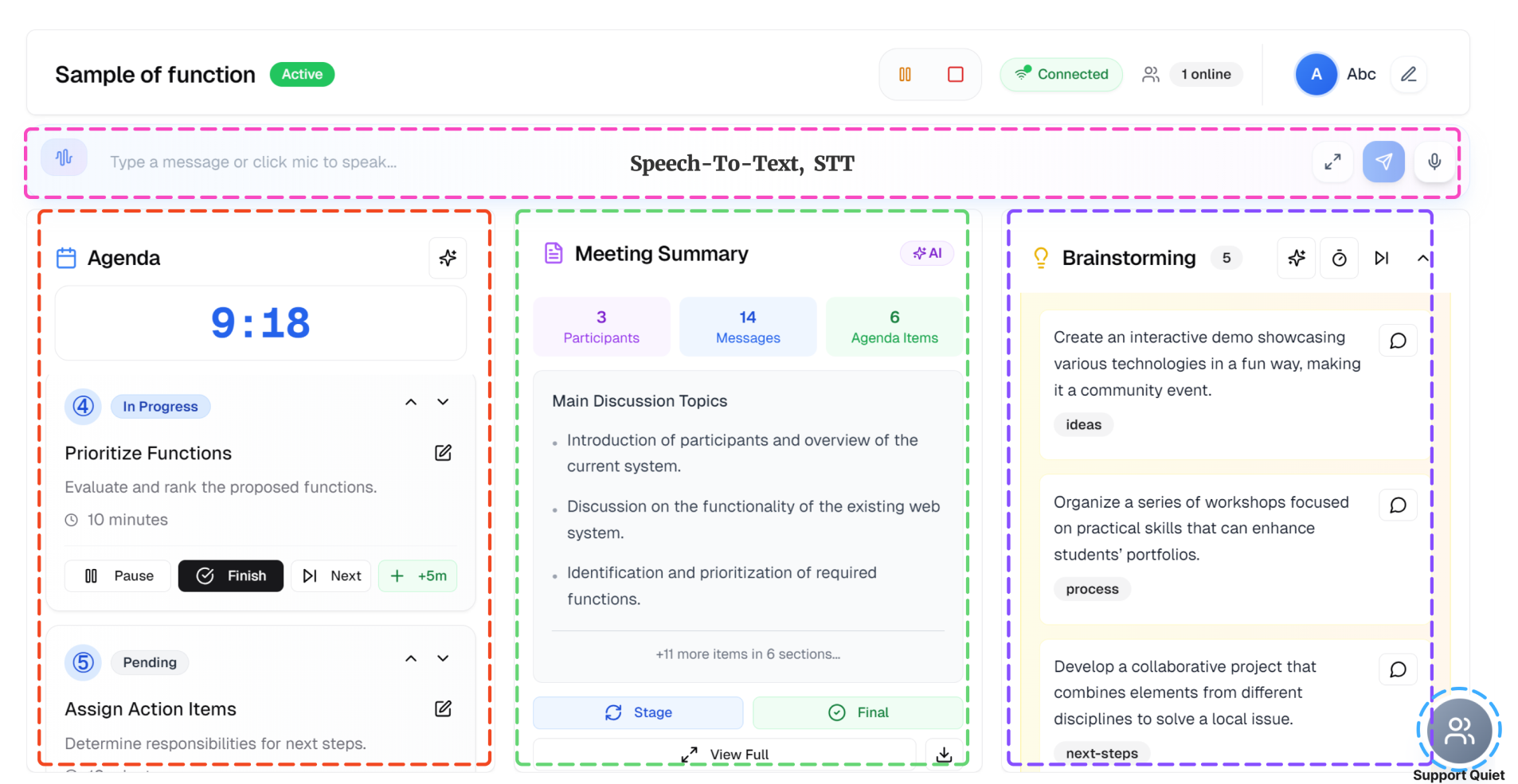
Figure 2: System Interface
Publication
Project Start Year - End Year
2024 - 2026
Project Collaborators
- Monash Action Lab: Delvin Varghese
- Adelaide University College of Education, Behavioural and Social Sciences: Flora Jin
Student Project
- ProDAIS: GenAI-Facilitated Collaborative Learning System for Productive Group Discussion in Information Technology Education
- Completed Monash Master’s Minor Thesis Project. Final Thesis Paper