
Immersive Contextual Data Analytics
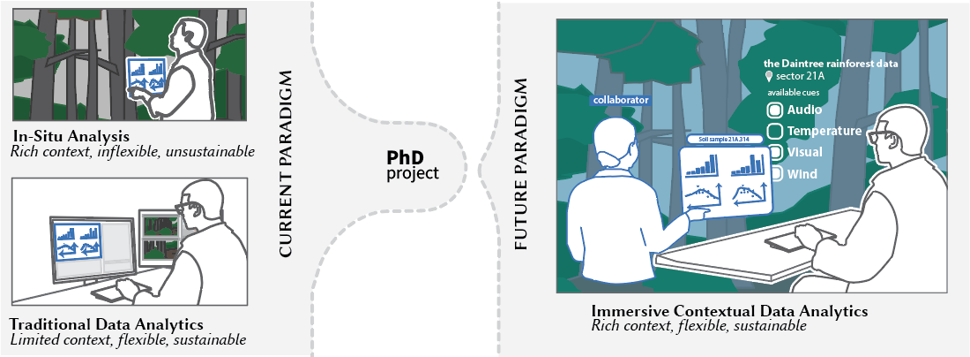
This project aims to leverage innovative spatial computing technologies and proposes Immersive Contextual Data Analytics (ICDA) as a method to address contextual analysis challenges by bringing rich contextual information to the analyst’s workspace. Despite the technological capability to support ICDA, there remains a lack of fundamental human-computer interaction research and usability design principles to realise practical and effective applications, particularly concerning how data visual analytics translates to this new method. This concept is aligned with a recently-developed terminology and conceptual model for blended real and virtual data representations, namely proxsituated (proxy of situated) visualisation and analytics. The concept of a proxy in this context refers to contextual information that serves as a representation or substitute for actual real-world data. This project will draw inspiration from research into how spatial awareness and context-specific memory function in mixed reality (MR) data analytics environments.
The ongoing research aims to understand how contextual environments influence users’ cognition and memory performance. In particular, it explores how environments influence users’ memory recall in industrial scenarios. Participants wear a VR headset (Meta Quest 3) and interact with dashboards to complete a series of data analysis tasks. The findings may inform the design and optimisation of situated systems and support the wider adoption of immersive technologies in industrial and research contexts.
Project Start Year
2026
Project Collaborators
- Monash Embodied Visualisation Research Group: Kadek Satriadi & Prof. Tim Dwyer
Student Project
- Impacts of Adaptive Contextual Immersive Environments in ProxSituated Data Analytics
- Ongoing Monash PhD Project.