Towards Intelligent Immersive Healthcare: A Systematic Literature Review
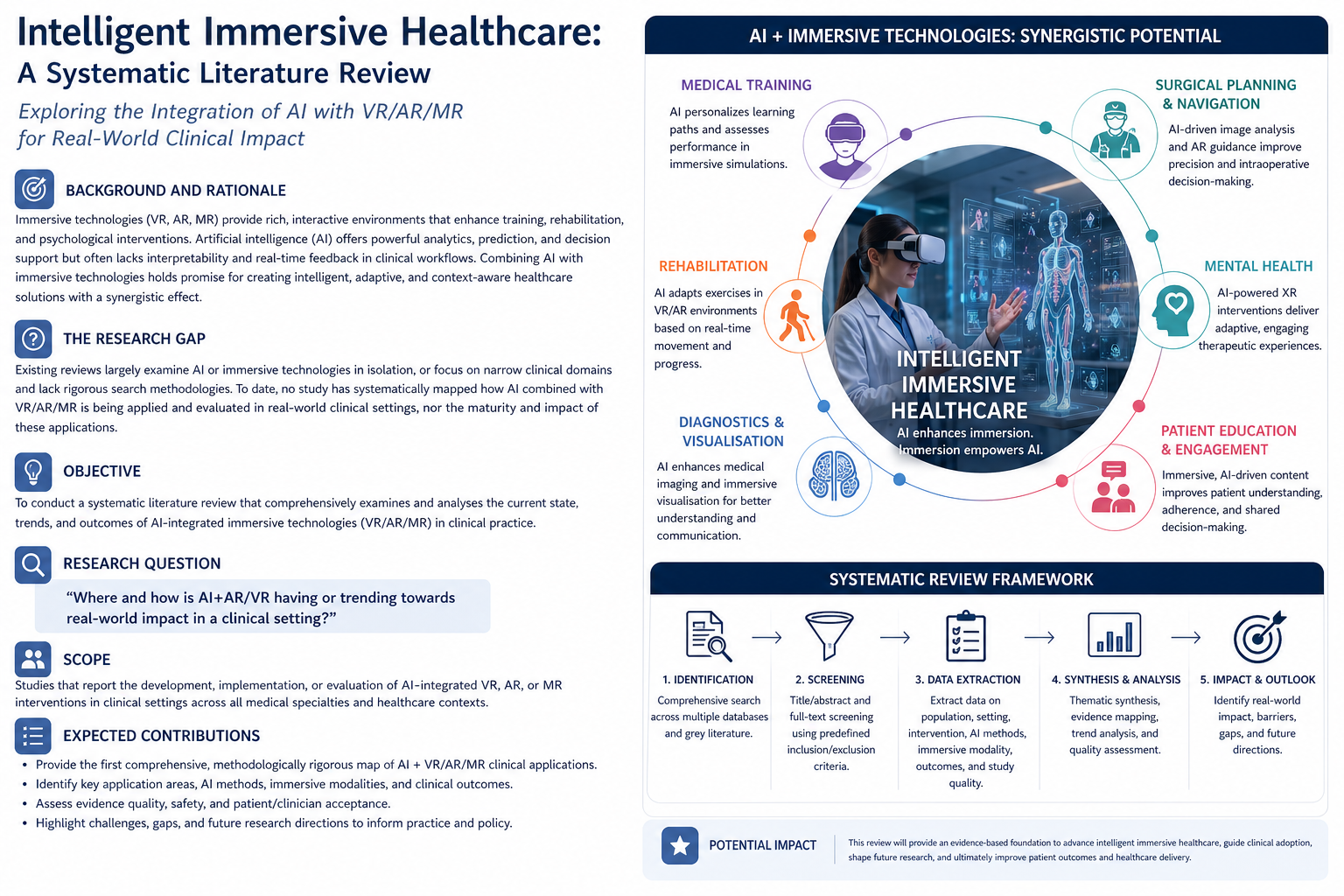
Immersive technologies—including virtual reality (VR), augmented reality (AR), and mixed reality (MR)—are increasingly transforming healthcare by embedding digital information into human perception and interaction. These technologies enable rich, interactive environments that support applications such as surgical training, rehabilitation, mental health interventions, and patient education. In particular, VR-based simulations provide safe, controlled, and repeatable training environments that have been shown to enhance knowledge acquisition, clinical reasoning, and procedural skills compared to traditional educational approaches.
At the same time, advances in artificial intelligence (AI) have significantly improved capabilities in medical diagnosis, prediction, and decision support. However, AI systems often lack interpretability, contextual awareness, and intuitive interfaces, which limits their integration into clinical workflows. Conversely, immersive technologies, while strong in visualisation and interaction, typically lack intelligent reasoning and adaptive feedback. This has led to growing interest in combining AI with immersive technologies, forming “intelligent immersive systems” where AI provides computational intelligence and immersive environments provide intuitive, human-centred interaction.
Emerging studies demonstrate the potential of this integration. For example, AI-driven adaptive VR systems can personalise rehabilitation tasks in real time, while AI-enhanced AR interfaces can support surgical navigation and decision-making. These systems suggest a synergistic relationship, where AI enhances immersion through adaptive and predictive capabilities, and immersive technologies improve the usability and interpretability of AI outputs. Despite these promising developments, current research remains fragmented, often focusing on isolated technologies, specific clinical domains, or narrow application contexts.
Existing review studies reflect this fragmentation. Many focus exclusively on AI in healthcare or on immersive technologies such as VR/AR in isolation, without systematically examining their integration. While some recent works explore AI-powered immersive systems, they are often limited in scope, lack comprehensive coverage across VR/AR/MR modalities, or do not follow rigorous systematic review methodologies. As a result, there is still no comprehensive, evidence-based understanding of how AI and immersive technologies are being combined in real-world clinical settings, nor how mature, effective, and acceptable these systems are in practice.
To address this gap, this project conducts a systematic literature review to comprehensively analyse the integration of AI with immersive technologies in healthcare. The review focuses on clinical applications and aims to map where and how these technologies are being used, evaluate their effectiveness, and identify trends, challenges, and research gaps. Guided by the central research question—“Where and how is AI + AR/VR/MR having or trending towards real-world impact in clinical settings?”—the study adopts a rigorous methodology including systematic search, screening, data extraction, and synthesis.
The expected contribution of this work is to provide the first methodologically rigorous and comprehensive synthesis of intelligent immersive healthcare systems. By identifying key application areas, technological approaches, evaluation methods, and evidence of clinical impact, the study aims to inform future research, support evidence-based adoption, and guide the design of more effective, interpretable, and scalable healthcare technologies.
Project Start Year - End Year
2025 - 2026
Project Collaborators
- Monash Embodied Visualisation Research Group: Agnes Haryanto, Yidan Zhang & Prof. Tim Dwyer
- University of Queensland Extended Reality Research Group: Ang Li
Student Project
- Towards Intelligent Immersive Healthcare: A Systematic Review on the Integration of AI with AR/VR in Medical Applications
- Completed Monash Master’s Minor Thesis Project. Final Thesis