
Spatial Cognition and Skills in Immersive Environments
My research explores how people perceive, remember, and navigate information in immersive technologies such as Virtual Reality (VR) and Augmented Reality (AR). As immersive environments enable information to be distributed throughout the user’s surrounding space, understanding the cognitive processes that support spatial interaction becomes increasingly important. In particular, I investigate how spatial memory and spatial cognition influence users’ ability to efficiently access, compare, and reason about information presented across large virtual and mixed-reality workspaces.
A central focus of my work is understanding how the spatial arrangement of information affects memory and performance. In VR, I have examined how different display configurations—ranging from traditional flat layouts to semicircular and fully wraparound arrangements—impact users’ ability to recall the locations and patterns of visual information. My findings challenge the common assumption that highly curved wraparound displays are always advantageous in immersive environments, showing that display geometry can significantly influence both memory performance and user experience.
I have also investigated spatial memory in Augmented Reality, where virtual information is embedded within physical environments. Unlike fully virtual settings, AR introduces an additional layer of interaction between virtual content and real-world surroundings. My research provides some of the first evidence that characteristics of the physical environment, such as the presence of furniture and environmental landmarks, can enhance users’ ability to remember and navigate spatially distributed virtual information. These findings highlight the important role that contextual cues play in supporting cognition in mixed-reality systems.
Collectively, this research contributes to a deeper understanding of human spatial cognition in immersive environments and informs the design of future immersive analytics, information visualization, and situated computing systems. By identifying how display layouts and environmental context shape spatial memory and navigation, my work helps establish evidence-based design principles for creating more effective, usable, and cognitively supportive VR and AR interfaces.
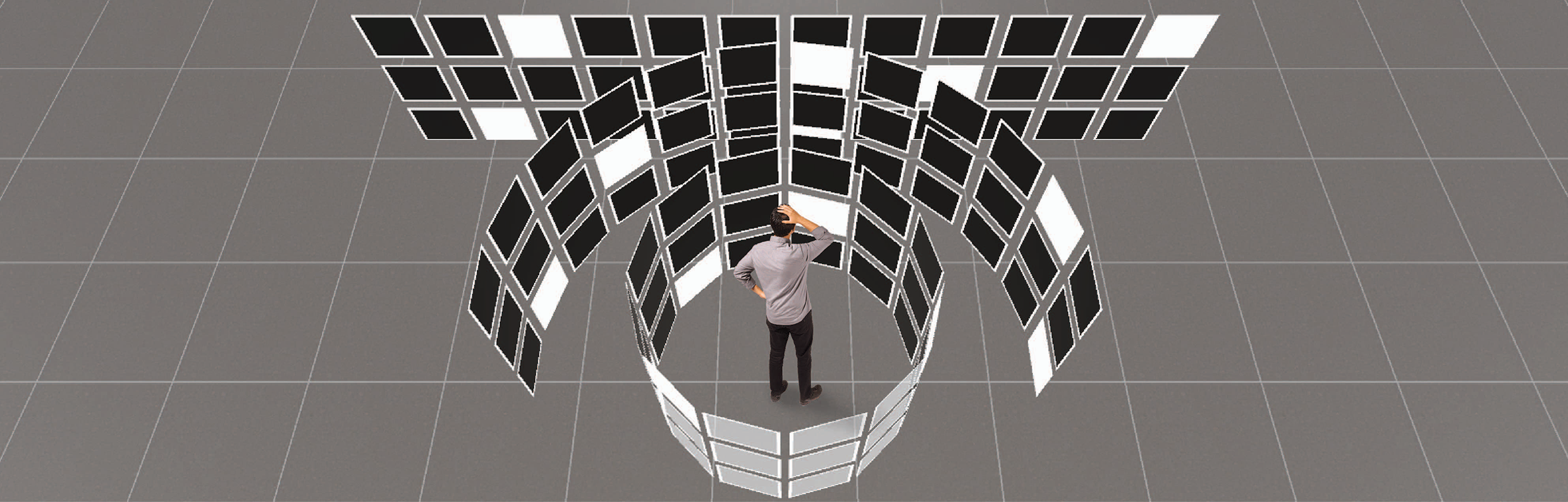
Figure 1: Spatial Memory Study in VR
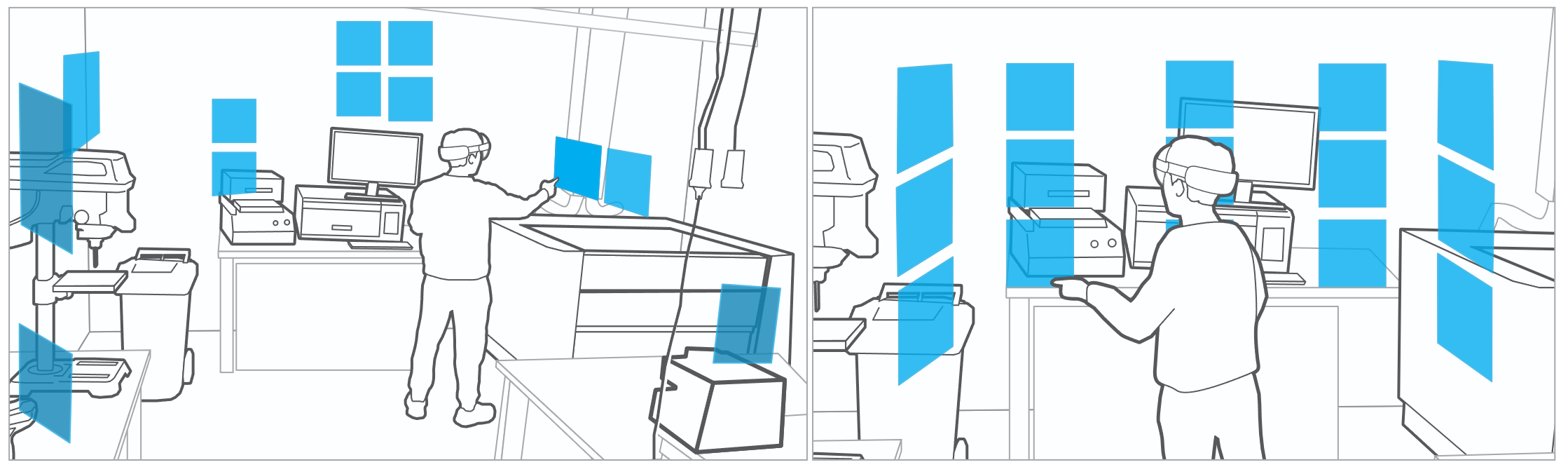
Figure 2: Spatial Memory Study in AR: Effect of physical landmarks on spatial memory
Project Start Year - End Year
2020 - 2022
Project Supervisors
- Monash Embodied Visualisation Research Group: Prof. Tim Dwyer
- The University of British Columbia: A/Prof. Barrett Ens
- French Institute for Research in Computer Science and Automation: Arnaud Prouzeau
Publication and Thesis
Liu, J., Satriadi, K.A., Ens, B. and Dwyer, T., 2024, October. Investigating the effects of physical landmarks on spatial memory for information visualisation in augmented reality. In 2024 IEEE International Symposium on Mixed and Augmented Reality (ISMAR) (pp. 289-298). IEEE. Publication Link
Liu, J., Prouzeau, A., Ens, B. and Dwyer, T., 2022. Effects of display layout on spatial memory for immersive environments. Proceedings of the ACM on Human-Computer Interaction, 6(ISS), pp.468-488. Publication Link