
Immersive View Management for Interactive Data Visualisation
Currently, data visualisation-as with most interactive computing tasks-is overwhelmingly performed using flat screens. However, for data that is inherently 3D, such as aircraft trajectories or building models, this presents a problem, as rendering 3D data displays on screens is well known to suffer from issues of occlusion, perspective distortion and so on, and generally, a loss of information.
On the other hand, as augmented and virtual reality (AR and VR) headset devices improve in tracking stability, field of view, and resolution, there is a real possibility that traditional screens may be cheaply replaced with wearable headsets that offer an immersive display of such 3D data. If headsets do replace screens, it presents both an opportunity and a challenge for data visualisation. It could be a paradigm shift in allowing immersive data visualisation in the context of other activities (i.e., situated analytics). But it will also represent an interaction design challenge in translating everything we have learned about visualisation design on flat screens to the spaces around us. How do we adapt all common visualisation idioms and interaction techniques to take advantage of this space?
In this research, we consider adapting a typical visualisation design pattern that is well studied on screens to immersive interaction spaces, namely small multiples displays. Small multiple views are faceted subsets of a whole entity, represented using the same visualisation idiom in a tiled display to support easy comparison. Small multiples displays are ubiquitous in many domains, e.g., stock market trading floors, scatterplot matrices, tiled medical images, etc. However, to our knowledge, layouts for small multiples have yet to be systematically explored or evaluated in 3D immersive environments.
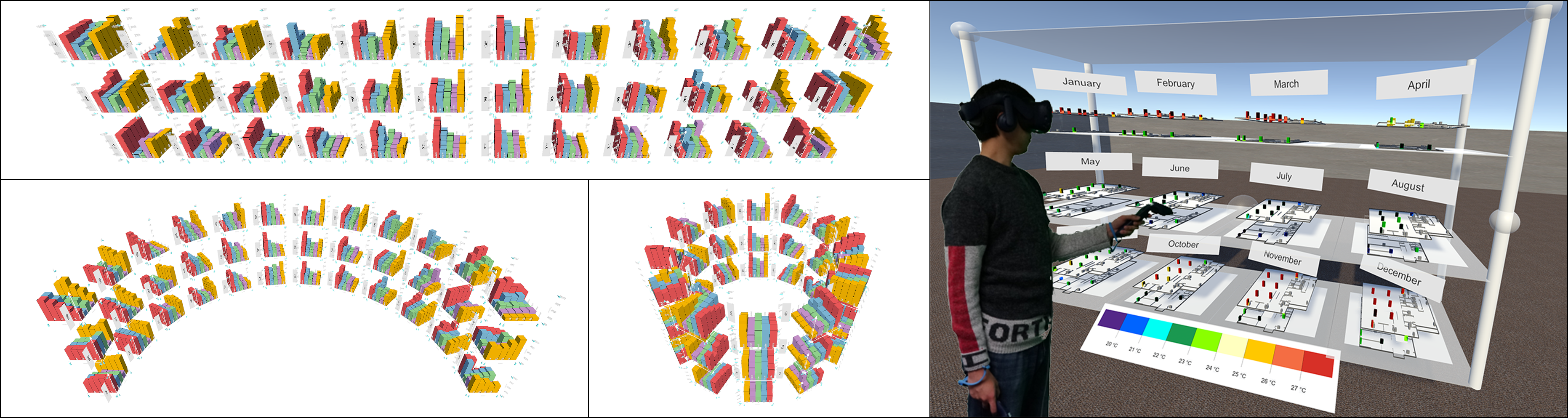
Figure 1: Left: different possibilities for layout curvature; right: small multiples presented in VR using a “shelves” metaphor.
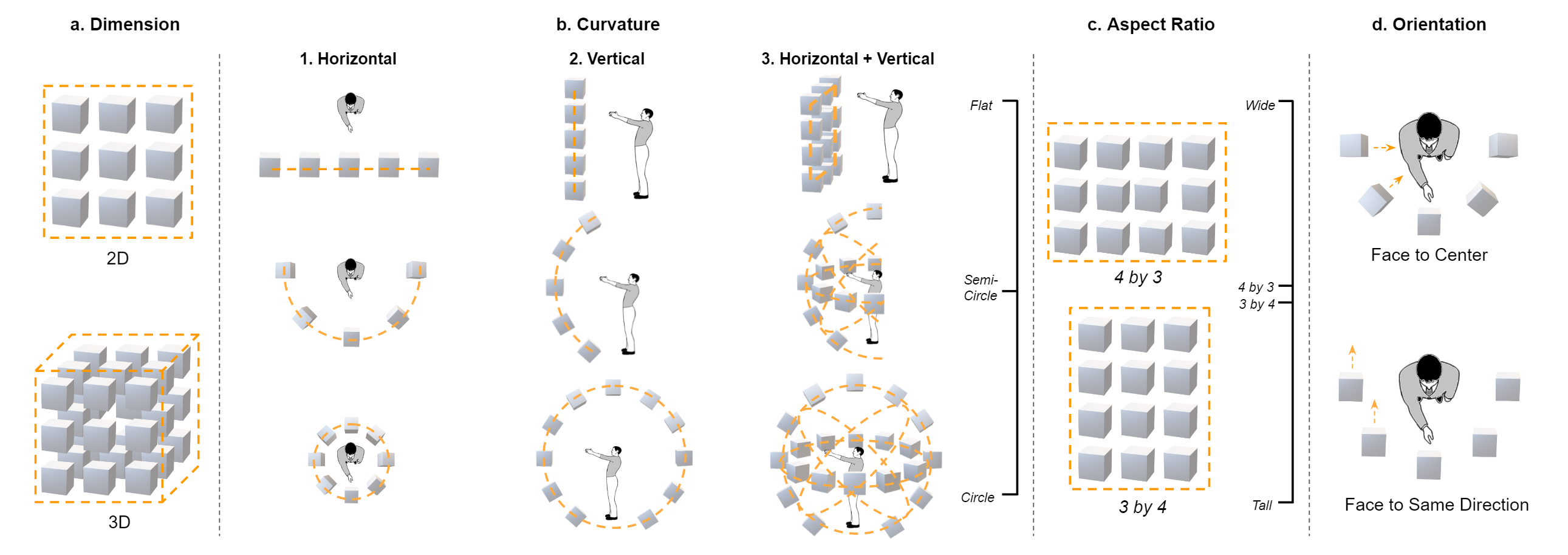
Figure 2: Immersive small multiples layout design space: (a) Dimension, (b) Curvature, (c) Aspect Ratio, and (d) Orientation.
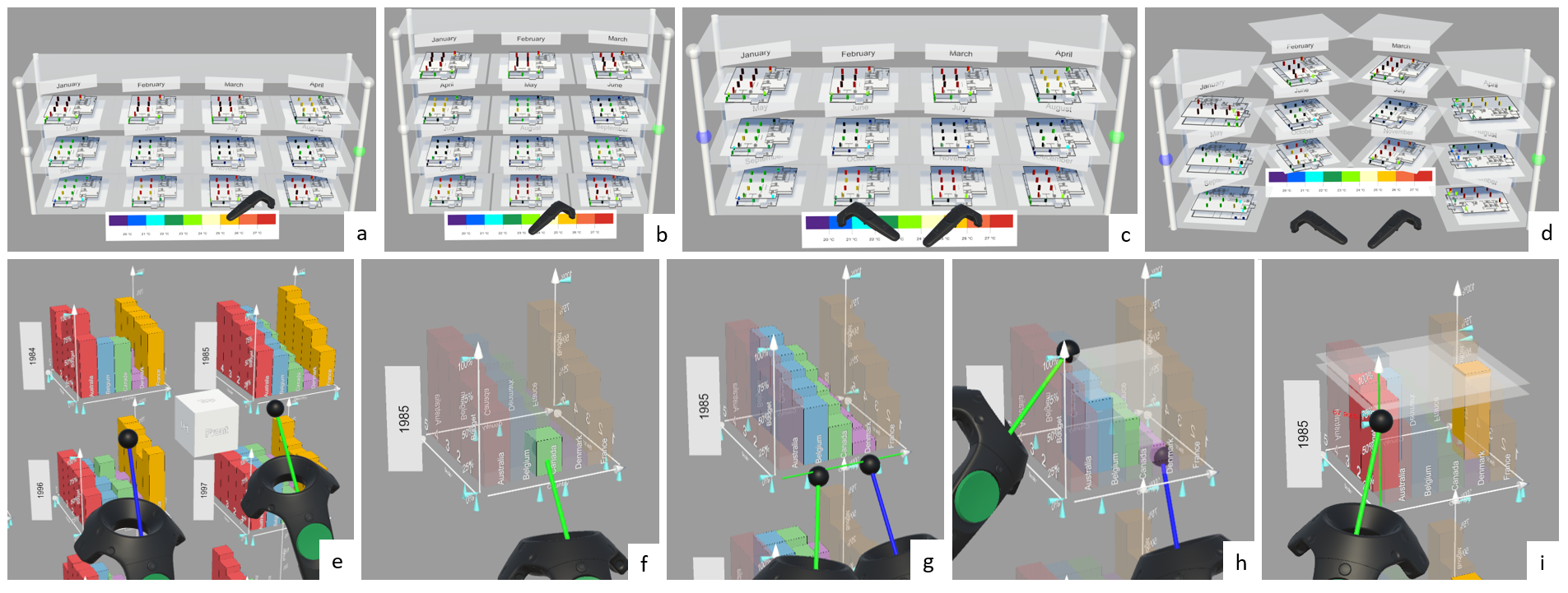
Figure 3: Interactions with the shelf layout (top) and contained data visualisations (bottom): (a,b) adjusting layout aspect ratio by “grabbing” and moving a shelf post, (c,d) adjusting layout curvature by moving both posts, (e) rotating multiples via the ViewCube, (f) brushing a single data point, (g) brushing an axis using both controllers, (h) brushing a volume selection on all axes, (i) filtering on the y-axis with cutting planes.
Project Start Year - End Year
2018 - 2020
Project Supervisors
- Monash Embodied Visualisation Research Group: Prof. Tim Dwyer
- The University of British Columbia: A/Prof. Barrett Ens
- French Institute for Research in Computer Science and Automation: Arnaud Prouzeau
Publication and Thesis
Liu, J., Prouzeau, A., Ens, B. and Dwyer, T., 2020, March. Design and evaluation of interactive small multiples data visualisation in immersive spaces. In 2020 IEEE conference on virtual reality and 3D user interfaces (VR) (pp. 588-597). IEEE. Publication Link